
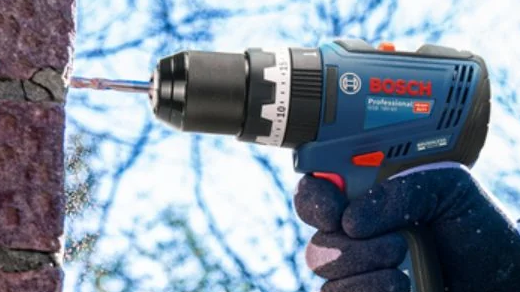
There is no single best cordless drill. The right one depends on which battery platform you commit to, whether you need hammer action or an impact driver, and your budget. This guide covers how to choose, then recommends specific models for different buyers. Every drill links straight to its page, where the price and stock are always current. If you would rather browse everything, start with the full cordless drill range.
How to choose a cordless drill
12V vs 18V
12V drills are smaller, lighter and easier to use one-handed, especially overhead or in tight spaces. They suit light drilling and driving screws into softwood, drywall or furniture. 18V drills have more torque and battery capacity, making them the standard choice for general building, decking, masonry and denser material. If you are buying one drill for mixed use around the house, 18V is the safer choice. Compare both in the cordless drills range, or look at corded drills if runtime matters more than portability.
Brushed vs brushless
Brushless motors run cooler, last longer and deliver more power and runtime from the same battery. They cost more but are now common even in mid-range tools. If two drills are similarly priced, the brushless one is usually the better long-term buy because there is less to wear out internally.
Drill/driver vs hammer drill vs impact driver
A standard drill/driver turns a bit continuously and suits wood, metal and occasional masonry with the right bit. A hammer drill adds a hammering action on top of rotation, which is what you need for repeated drilling into brick, block or concrete. For heavier masonry, an SDS Plus drill uses a different chuck system and hits harder again. An impact driver delivers rotational impacts rather than hammer blows, driving long screws and bolts far more easily, but it is not designed for drilling into masonry. Many buyers end up with a drill and an impact driver as a pair.
Bare tool (solo) vs kit
Many drills are sold bare or solo, meaning no battery or charger is included. These suit buyers who already own batteries on that brand's platform. If this is your first tool on a platform, buy a kit that includes at least one battery and a charger, or add them separately from our batteries and chargers ranges.
Amp-hours (Ah)
This is the battery's capacity: a higher Ah rating means longer runtime between charges, at the cost of a heavier battery. A 2.0Ah battery is fine for most home use. Trade users doing all-day work benefit from 4.0Ah or 5.0Ah batteries. It is worth keeping a spare, so one is charging while you work.
Chuck size and bits
Chuck size determines the largest bit shank the drill can hold. Most cordless drills use a 10mm or 13mm chuck, with 13mm generally found on larger, higher-torque hammer drills. Whichever drill you choose, budget for decent consumables: a drill bit set covering wood, masonry and metal, a set of screwdriver bits, and hole saws if you cut larger openings. Cheap bits blunt fast and make a good drill feel poor.
Shop cordless drills by brand
If you already know which battery platform you are on, go straight to it: DeWalt cordless drills, Bosch cordless drills or Makita cordless drills. Otherwise the full cordless drill range covers every brand we carry.
Recommendations by use case
Each drill below links to its product page, where you can check the current price, stock and add it to your basket.
Occasional DIY and home use
For putting up the odd shelf, assembling flat-pack furniture or light repairs a few times a year, you do not need a trade-grade tool. Look for something light, simple and inexpensive enough that it is not wasted sitting idle.
-

Einhell Cordless Drill TC-CD 18/35 Li - Solo — an affordable entry onto Einhell's 18V platform if you already have a battery. Straightforward and light for basic drilling and driving. Check price and buy → -

Bosch Professional Drill Driver GSB 183-LI (1 battery) — comes with a battery, so it is ready to use out of the box. A sensible first drill from a well-known brand. Check price and buy → -

Einhell TE-CD 12/1 Li (1x2,0Ah) — a 12V option with a battery included, worth considering if you want something smaller and lighter around the house. Check price and buy →
Regular DIY and home renovation
For frequent projects, room renovations or deck building, step up to more torque and a larger battery so you are not stopping to recharge. A second battery from the batteries range pays for itself on a long weekend of work.
-

Bosch Professional Drill/Driver GSR 18V-65 — solid mid-range torque on an 18V platform, suited to regular drilling and driving across a range of materials. Check price and buy → -

Einhell Cordless Impact Drill TE-CD 18/2 Li-i +22 — hammer action for occasional masonry, plus a battery and accessories, useful for a renovation with mixed materials. Check price and buy → -

DeWalt DCD706D2-QW 12V Drill Driver — a compact 12V option for renovation work where manoeuvrability in tight spots matters as much as power. Check price and buy →
Daily trade use
Tradespeople need tools that survive daily use and run a full working day. This is where brushless motors and higher-capacity batteries earn their keep. Most trade buyers pair a drill with an impact driver on the same platform.
-

DeWalt 18V Brushless Hammer Drill DCD996NT-XJ (bare) — a brushless hammer drill sold bare, for tradespeople already on the DeWalt 18V XR platform. Add DeWalt batteries if you need them. Check price and buy → -

Bosch Professional Impact Drill GSB 18V-52 (3 x 2Ah kit) — three batteries included, so you keep working without waiting for a charge. Check price and buy → -

Hikoki 18V Impact Driver Drill DV18DE 4.0Ah set — a complete set with 4.0Ah batteries, built for sustained daily use on site. Check price and buy →
Woodworking and cabinetmaking
Woodworkers want precision, control and light, well-balanced tools that can be used for long periods, with fine torque settings for accurate driving into timber and boards.
-

Festool TXS 12 2,5-Plus — a compact 12V drill from a brand well regarded in fine woodworking for control and build quality. Check price and buy → -

Festool CXS 18 C 3,0-Plus — an 18V option for workshop use where more torque is needed but precision remains the priority. Check price and buy → -

Makita 18V LXT Brushless Drill DHP484ZJ (solo) — a brushless option on Makita's widely used LXT platform, practical if you already run other Makita cordless tools. Check price and buy →
Heavy masonry work
Drilling repeatedly into brick, block or concrete needs sustained hammer action and higher torque. If you are drilling anchor holes all day, also consider an SDS Plus rotary hammer, which is built for it.
-

Metabo Cordless Hammer Drill SB 18 LTX BL Q I — a brushless hammer drill from Metabo's professional range, built for repeated masonry drilling. Check price and buy → -

Bosch Professional Impact Drill GSB 18V-90 C (solo) — higher-output hammer drill for demanding masonry and construction work. Check price and buy → -

Hikoki 36V Impact Driver Drill DV36DC (basic) — a 36V platform tool offering higher power for the heaviest masonry and construction tasks. Check price and buy →
Battery platforms: why it pays to pick one
Almost every cordless drill is part of a battery platform: a family of tools sharing batteries and chargers. Once you own a battery and charger, adding a bare tool on that platform is far cheaper than buying a full kit each time. This is why many trade users standardise on one brand. It is worth deciding which platform to build into before buying your first tool, especially if you plan to add more cordless tools later.
We carry DeWalt, Bosch Professional, Einhell, Festool, Makita, Metabo and Hikoki. Spare batteries and chargers are stocked for all of them.
Do not forget the consumables
A drill is only as good as what you put in it. Most buyers add a drill bit set and a set of screwdriver bits at the same time, plus individual drill bits in the sizes they use most.
Buying from Power Tool Services
Browse the full cordless drill range to compare current prices and stock, or narrow it down by brand: DeWalt, Bosch or Makita. We stock these at our store in Claremont, Cape Town, with nationwide courier delivery, and orders over R2,000 qualify for free delivery. Our staff use these tools themselves, so if you are unsure which drill suits your job, get in touch before you buy.