
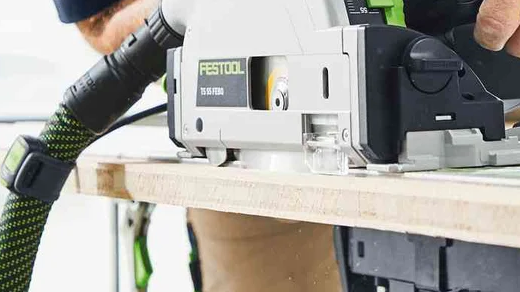
Track saw vs circular saw: which do you need?
Every week someone walks into our Cape Town shop holding a phone picture of a Festool TS 55 and asks whether they really need one, or whether their circular saw with a straight edge is good enough. The honest answer is that both tools cut a straight line through a board. The difference is how much work you do before and after the cut, and what the edge looks like when you are done.
This guide explains what a track saw (also called a plunge saw) actually does differently, which models we stock from Festool, Makita, Bosch and Metabo, and when a circular saw with a guide rail is the smarter buy. Prices are from our store on the day of writing. Everything ships nationwide, free over R2,000. See the full plunge and track saw collection.
What a circular saw does
A hand-held circular saw is a motor, a blade and a flat base. You draw a line, line up the notch on the base and push. It is fast, cheap and cuts deep: the Bosch GKS 190, for example, has a 190 mm blade with 70 mm of depth at 90 degrees and costs a fraction of any track saw. For framing timber, decking, roof battens and rough carcass work, nothing beats it.
Its weakness is the finish. The blade starts outside the material, so it tears the top face of melamine and veneered board. The cut follows your hand, so any wobble shows. And a straight edge clamped to the work puts the blade an unknown distance from the edge, so you measure, offset, clamp and hope.
What a track saw does differently
A track saw is a circular saw that is designed around a guide rail from day one. Four things change.
- The blade plunges. The saw sits flat on the rail with the blade retracted. You push down to plunge into the board, so you can start a cut in the middle of a panel and cut sink openings or stop cuts.
- The rail has a splinter guard. A rubber strip on the rail edge is trimmed by the blade on the first cut. After that the strip sits exactly on the cut line, supports the fibres and marks where the cut will land. You set the rail on your pencil line and cut. No offset.
- The saw cannot wander. Ribs on the rail hold the saw base. The cut is as straight as the rail, which is straighter than anything you own.
- Dust extraction works. The blade is shrouded, so a 27 or 36 mm hose captures most of the dust. For cutting melamine indoors, this matters.
Trade-offs: shallower cuts (55 to 62 mm on the 160 to 168 mm saws here), a higher price, and the rail gets in the way for quick rough cuts.
The track saws we stock
Festool TS 55 FEBQ-Plus-FS
The Festool TS 55 FEBQ-Plus-FS (from R15,165) is the saw everyone else is measured against. The current version uses a thin-kerf 160 mm blade, cuts 55 mm deep at 90 degrees and 43 mm at 45, bevels from minus 1 to 47 degrees, and weighs 4.5 kg. The set includes the FS 1400/2 guide rail, splinter guard and a Systainer. The angle stays on the cut line when you tilt the saw, which is the detail that makes mitred cabinet sides possible.
Festool TS 60 KEBQ-Plus-FS
The Festool TS 60 KEBQ-Plus-FS (from R15,999) is the newer, bigger brother. A brushless EC-TEC motor with 1,500 W drives a 168 mm blade for 62 mm of cutting depth, enough for 60 mm kitchen island tops and thick benchtops in one pass. It adds KickbackStop, which stops the blade if the saw jerks back during a plunge, and it combines with Festool's FSK cross-cutting rails for angled cuts. The set includes the FS 1400/2 rail. For most people choosing between the two Festools, the extra 7 mm of depth and the kickback protection are worth the small premium.
Both Festools have cordless siblings in the Festool track saw range if you work away from power.
Makita SP6000J
The Makita SP6000J plunge saw with 1400 mm rail and clamps (from R9,999) is the value buy in the category. A 1,300 W motor, 165 mm blade, 56 mm depth at 90 degrees and 40 mm at 45, variable speed from 2,000 to 5,800 rpm, and a 2 mm scoring setting for splinter-free preliminary cuts in melamine. It weighs 4.4 kg and comes with a 48-tooth blade, rail clamps and a Makpac case. Makita rails fit Festool-pattern saws and vice versa in most cases, which makes the SP6000 an easy saw to live with.
Bosch GKT 55 GCE
The Bosch GKT 55 GCE (from R11,799) has the strongest motor of the corded saws here at 1,400 W, with speed adjustable from 3,600 to 6,250 rpm and constant electronics for cutting aluminium and acrylic as well as wood. It runs a 165 mm blade with a 20 mm bore, bevels from minus 1 to 47 degrees and weighs 4.7 kg. Note that it ships as the bare saw with a 48-tooth blade; the FSN 1600 guide rail (from R1,489) is sold separately, so budget for the pair.
The middle path: a circular saw built for rails
If you want straight, clean cuts in sheet material but cannot justify R10,000 plus, there is a third option. Some circular saws have a base machined to ride on a guide rail, without the plunge mechanism.
The Metabo KS 55 FS (from R2,589) is the one we recommend. It has a die-cast aluminium base that is directly compatible with Festool, Bosch, Makita, HiKOKI, Mafell and Hilti rails, a 1,200 W motor, a 160 mm blade and 55 mm of depth at 90 degrees (50 mm on a rail). Pair it with a Festool or Makita rail and you get the no-offset, no-wander benefit of a track saw for less than a third of the price. You give up the plunge start and some of the dust control.
For a conventional circular saw, the Kreg Rip-Cut edge guide (from R999) clamps to most saws, left or right blade, and references off the sheet edge for repeat rips up to 24 inches (610 mm). It will not fix tear-out, but it fixes wander and removes the measuring.
Comparison table
| Saw | Type | Blade | Depth at 90° | Weight | Rail included | From |
|---|---|---|---|---|---|---|
| Festool TS 55 FEBQ-Plus-FS | Plunge / track | 160 mm | 55 mm | 4.5 kg | FS 1400/2 | R15,165 |
| Festool TS 60 KEBQ-Plus-FS | Plunge / track | 168 mm | 62 mm | 4.8 kg | FS 1400/2 | R15,999 |
| Makita SP6000J | Plunge / track | 165 mm | 56 mm | 4.4 kg | 1400 mm + clamps | R9,999 |
| Bosch GKT 55 GCE | Plunge / track | 165 mm | not stated | 4.7 kg | No | R11,799 |
| Metabo KS 55 FS | Circular, rail-compatible | 160 mm | 55 mm | 4 kg | No | R2,589 |
| Kreg Rip-Cut | Edge guide for any circular saw | n/a | n/a | n/a | n/a | R999 |
Specifications come from the manufacturers' data on our product pages. Prices are correct at the time of writing.
So which do you need?
Ask yourself three questions.
- Do you cut melamine, veneered board or laminate more than once a month? If yes, a track saw. Tear-out on a kitchen carcass costs more in wasted board than the saw does.
- Do you need to start cuts inside a panel? Sink cut-outs, hob openings, flooring repairs. If yes, you need a plunge saw; a circular saw cannot do this safely.
- Is most of your cutting rough timber, decking or framing? If yes, a circular saw. Buy a good one from our circular saw range and add a Kreg guide.
Our pick for...
- Kitchen fitters and cabinet makers: Festool TS 60 KEBQ-Plus-FS. The 62 mm depth and KickbackStop make it the complete tool.
- The classic choice: Festool TS 55 FEBQ-Plus-FS. Lighter, proven, and every accessory ever made fits it.
- Best value plunge saw: Makita SP6000J. Rail and clamps included for under R10,000.
- Mixed materials including aluminium: Bosch GKT 55 GCE for its speed range and 1,400 W motor. Add the FSN 1600 rail.
- Straight cuts on a budget: Metabo KS 55 FS on a Festool or Makita rail.
- Already own a circular saw: Kreg Rip-Cut.
Frequently asked questions
Is a plunge saw the same as a track saw?
In everyday use, yes. "Plunge saw" describes the retracting blade; "track saw" describes the rail it runs on. The Festool, Makita and Bosch saws above are both.
Will a Makita rail fit a Festool saw?
Makita and Festool rails share the same profile and generally interchange, as do Bosch FSN rails. The Metabo KS 55 FS is designed to fit all of them. Rail-to-rail connectors and splinter guards are brand specific, so buy those to match the rail. See guide rails and rail accessories.
How long a rail do I need?
The 1,400 mm rail supplied with the Festool and Makita sets crosscuts a 1,220 mm sheet with room to spare. To rip a full 2,440 mm sheet you join two rails with a connector or buy a 3,000 mm rail. Most people start with the included rail and add a second 1,400 later.
Can a track saw replace a table saw?
For sheet goods, yes, and it is safer and needs less space. For ripping narrow strips from solid timber, repeat cuts and anything under about 100 mm wide, a table saw is still faster. Many small workshops run both; see our table saw guide and range.
Do I need a dust extractor with a track saw?
Not to cut, but you will want one. The shrouded blade on a plunge saw makes extraction very effective, and every saw here has a 27 or 36 mm port. Our dust extraction collection has options from R4,000.
What blade comes with the saw, and what else should I buy?
All four track saws ship with a fine-tooth blade for wood and board. For aluminium, solid surface or laminate flooring, buy a dedicated blade from our blade range; the 160, 165 and 168 mm diameters and 20 mm bore are listed on each product.