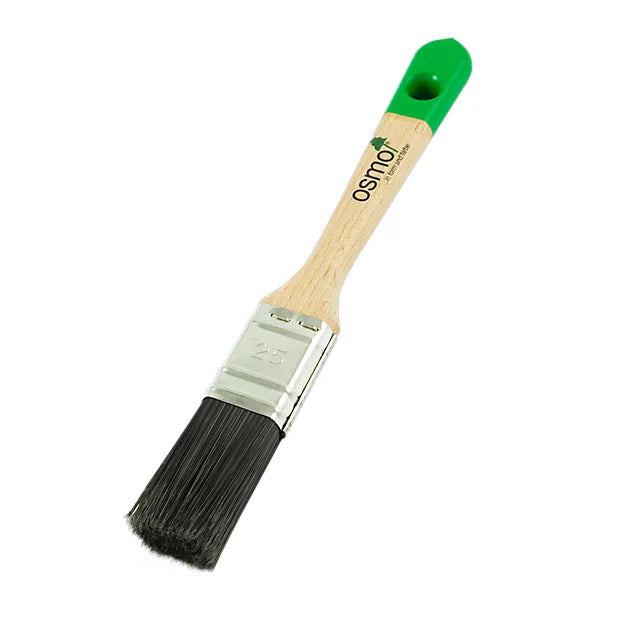
Osmo hardwax oil, wood wax and oil finishes for floors, furniture, worktops, doors, decks and cladding. Polyx-Oil, Top-Oil, Decking Oil, UV-Protection-Oil, Oil Stain, Wood Wax Finish and the brushes to put them on, held in stock in Cape Town and couriered anywhere in South Africa.
Natural oils and waxesSunflower, soya, thistle and linseed oils with carnauba and candelilla wax. Plant based, no beeswax.
Soaks in, never peelsMicroporous: the oil penetrates and the wax repels water and dirt, so it cannot crack, flake or blister.
Highest coverageAbout 24 m² per litre per coat for Polyx-Oil and Decking Oil, twice a conventional finish, because it goes on thin.
Repair, do not stripA worn patch is cleaned and re-oiled in place. No sanding back, no primer, no sanding between coats.
Three questions
Find your Osmo finish
The same three questions we ask at the counter. Osmo's own product finder works the same way: inside or outside, then where the wood is, then the look you want.
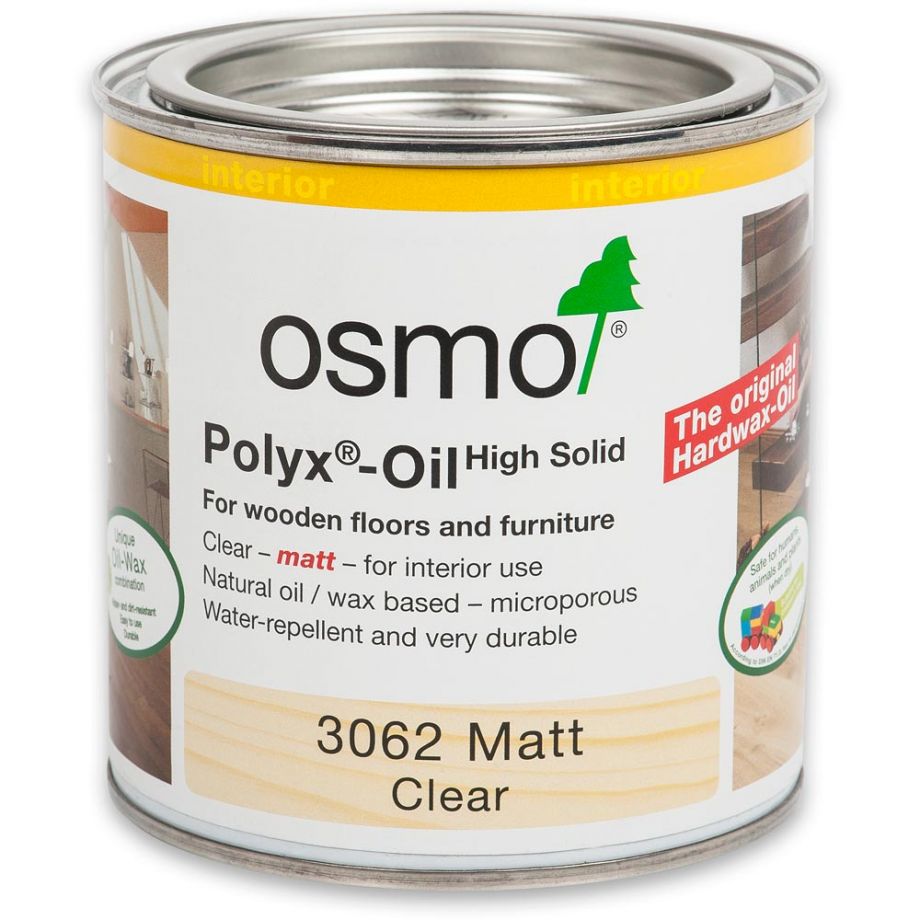
The original hardwax oil for wooden floors. Two thin coats, about 24 m² per litre per coat, 8 to 10 hours between coats. Need the floor back in a day? Polyx-Oil Rapid (3232 satin, 3262 matt) dries in 4 to 5 hours.
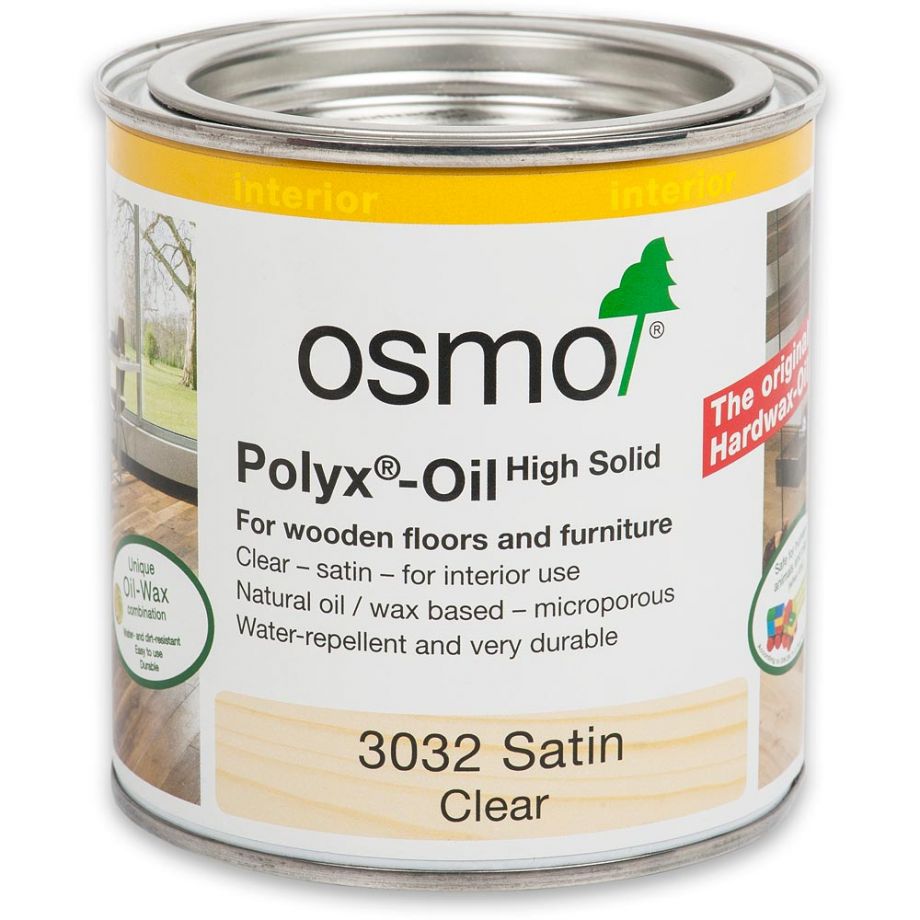
Our advice: 3032 satin for most homes; 3062 matt if you want the bare-timber look and the best hiding of wear.
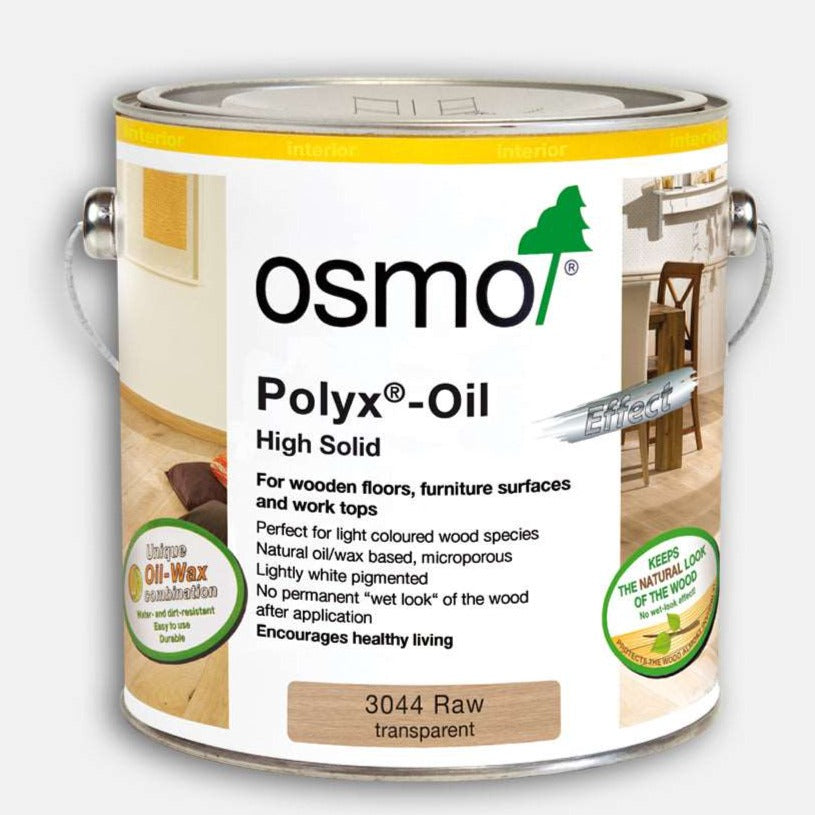
A trace of white pigment stops oak, ash, maple and whitewood going amber, so the floor keeps the look of freshly sanded timber. Our bestselling Osmo product.
Our advice: on very pale timber apply it exactly as thin as the tin says; too thick and it reads as a wash.
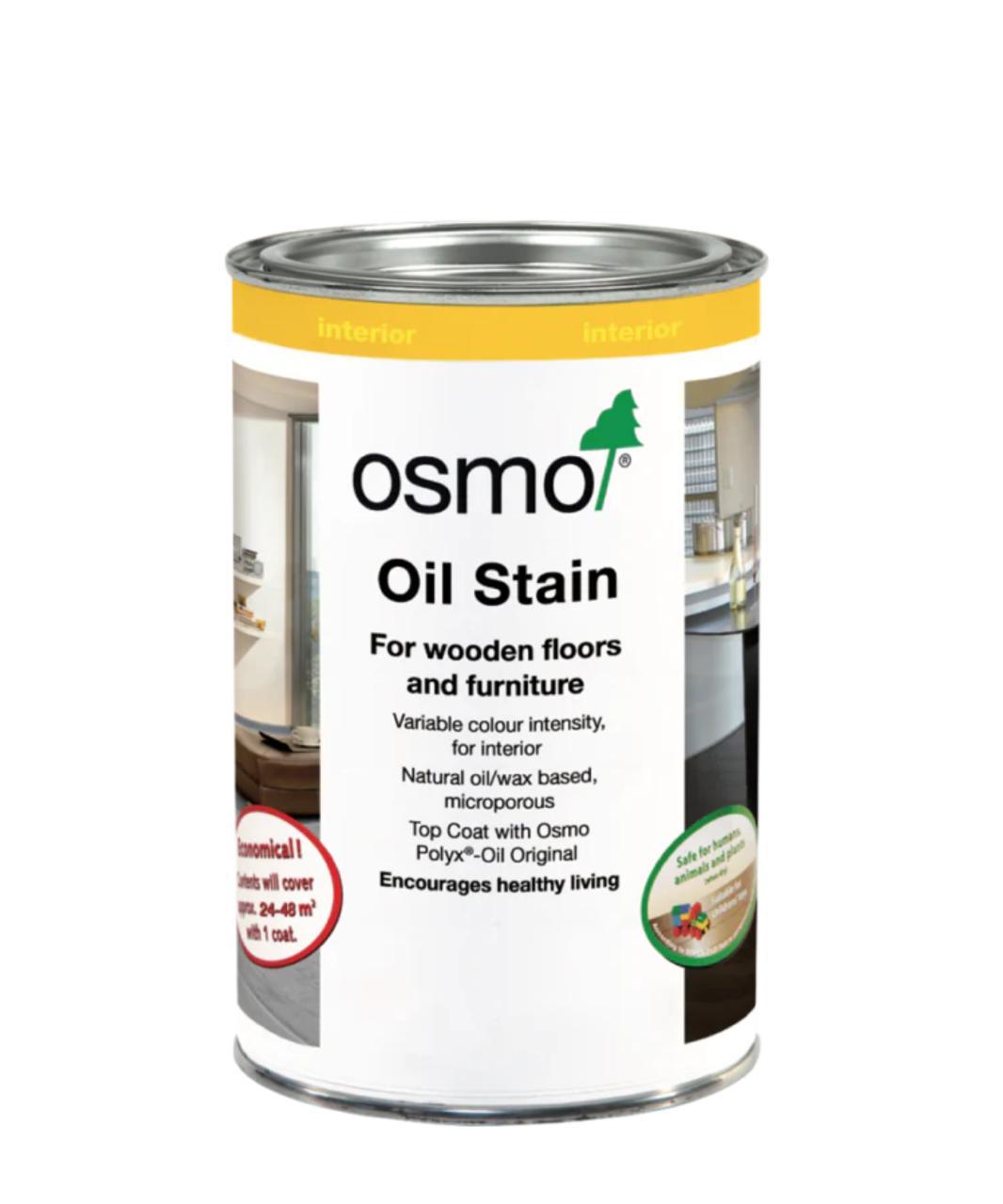
Oil Stain under clear Polyx-Oil, or Polyx-Oil Tints
Oil Stain 3501 White to 3590 Black · Tints 3040 to 3075
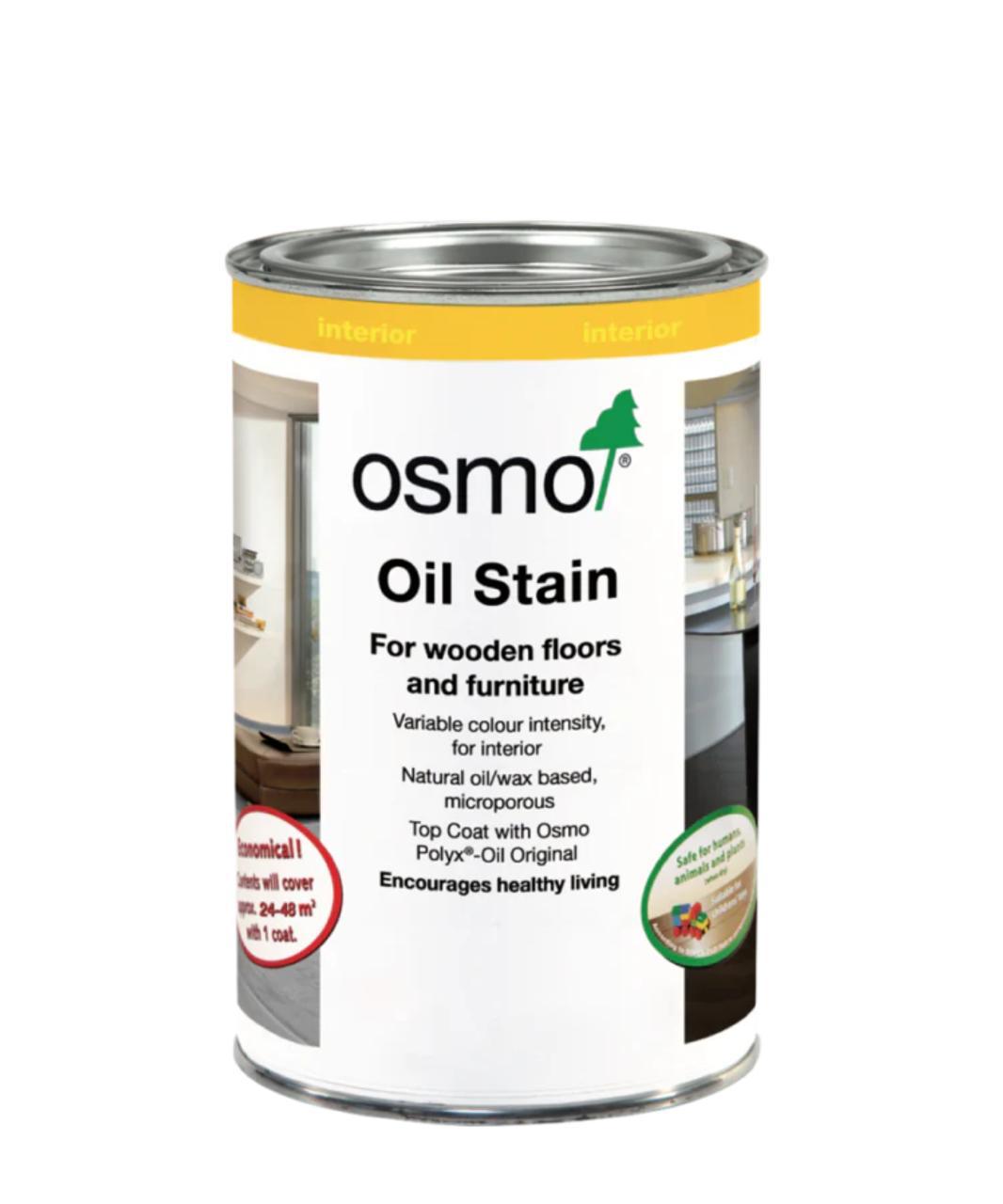
Oil Stain is one thin coat of colour sealed with clear Polyx-Oil, so a coloured floor still wears like a clear one. Tints colour and seal in one coat with clear on top. Not for teak, mahogany or other oily tropical timbers.
Our advice: colour looks different on every species. Test the tint with a 5 ml sachet on an offcut before you buy the tin.
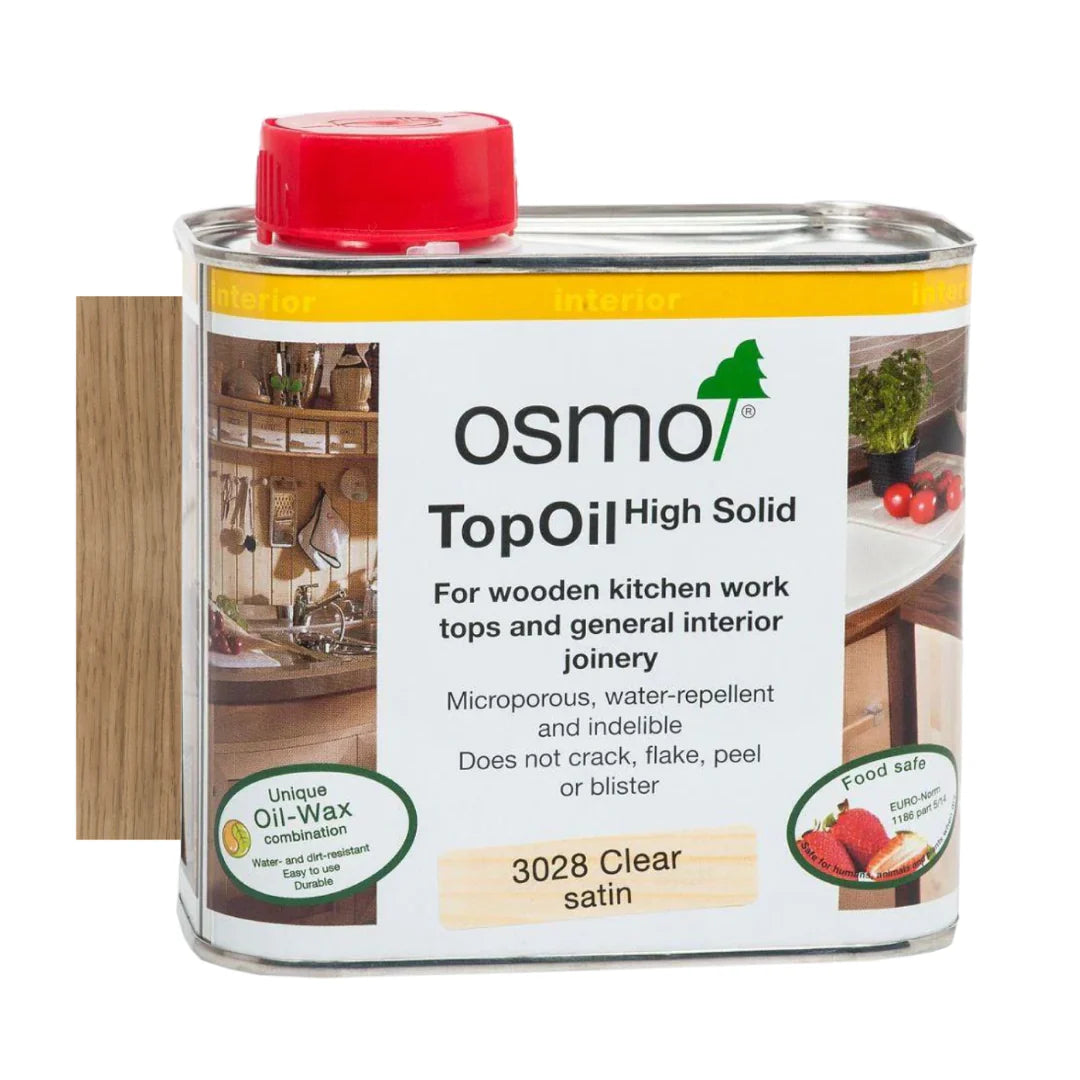
The food-safe oil for kitchen worktops and tables (EN 1186 once cured). Thin coats by cloth, 8 to 10 hours apart; spot-repair around the sink without stripping.
Our advice: buy a 5 ml sachet first. Clear and Natural look very different on oak and beech.
Wood Wax Finish Transparent and Intense Colours · Oil Stain 3501 to 3590
Wood Wax Finish gives colour and protection in one, from a translucent wash to solid white or black, and is toy safe. Oil Stain is a thin colour coat sealed with clear Polyx-Oil.
Our advice: Intense Colours for children's furniture and panelling; Oil Stain for a stained-and-sealed oak look.
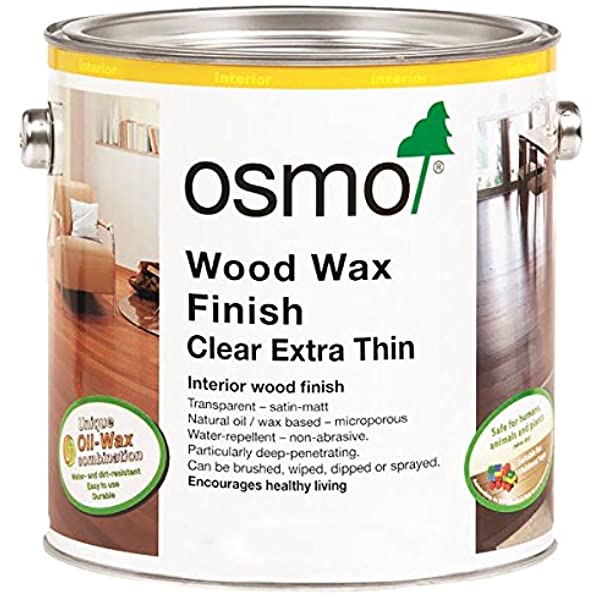
The thin wax for wood that will not take a normal hardwax oil: teak, kiaat, wenge, rosewood and other dense or oily timbers. Also the thinner for the rest of the range.
Our advice: wipe the surface with a lint-free cloth first and go very thin; oily timbers hold the finish on the surface if you flood them.
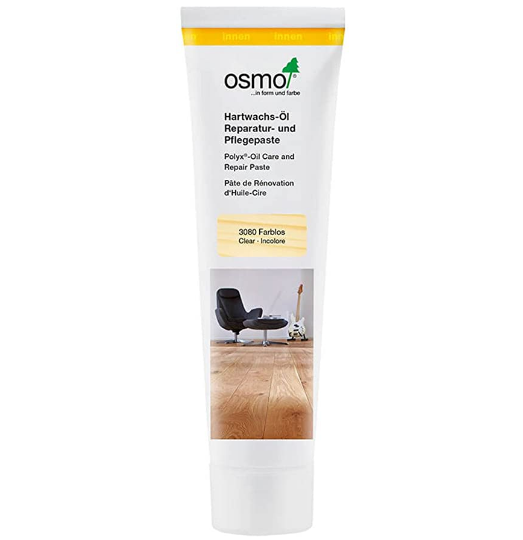
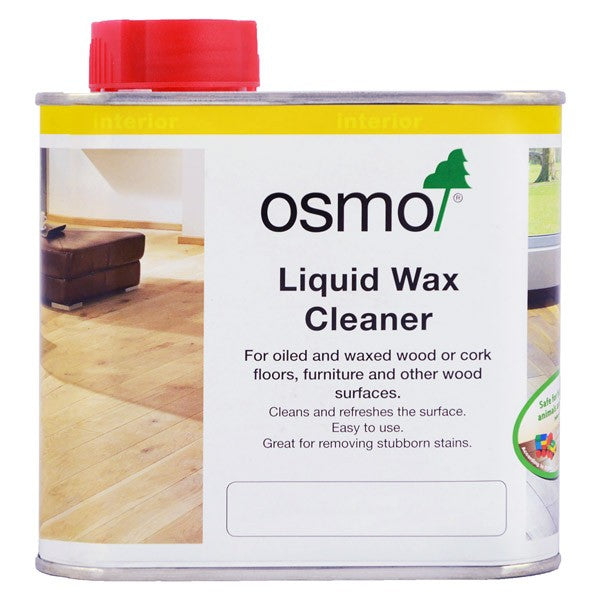
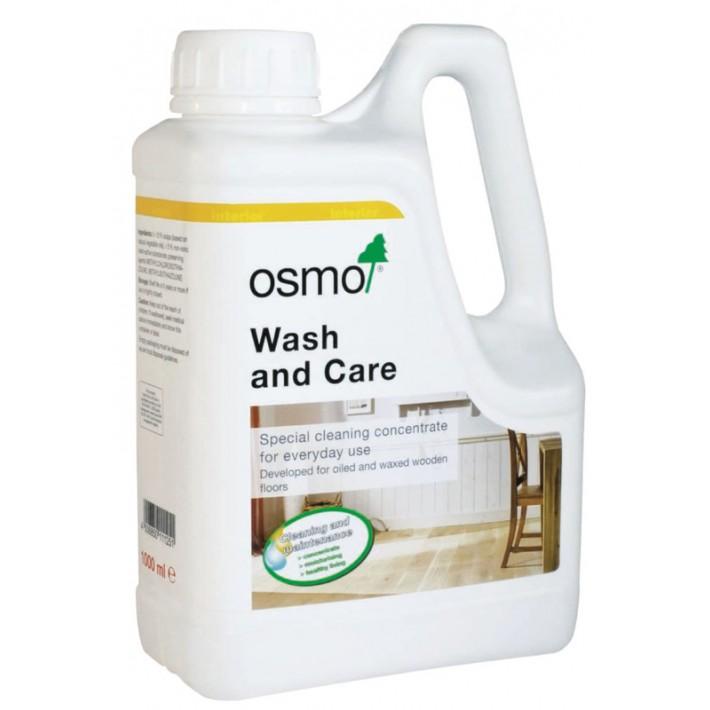
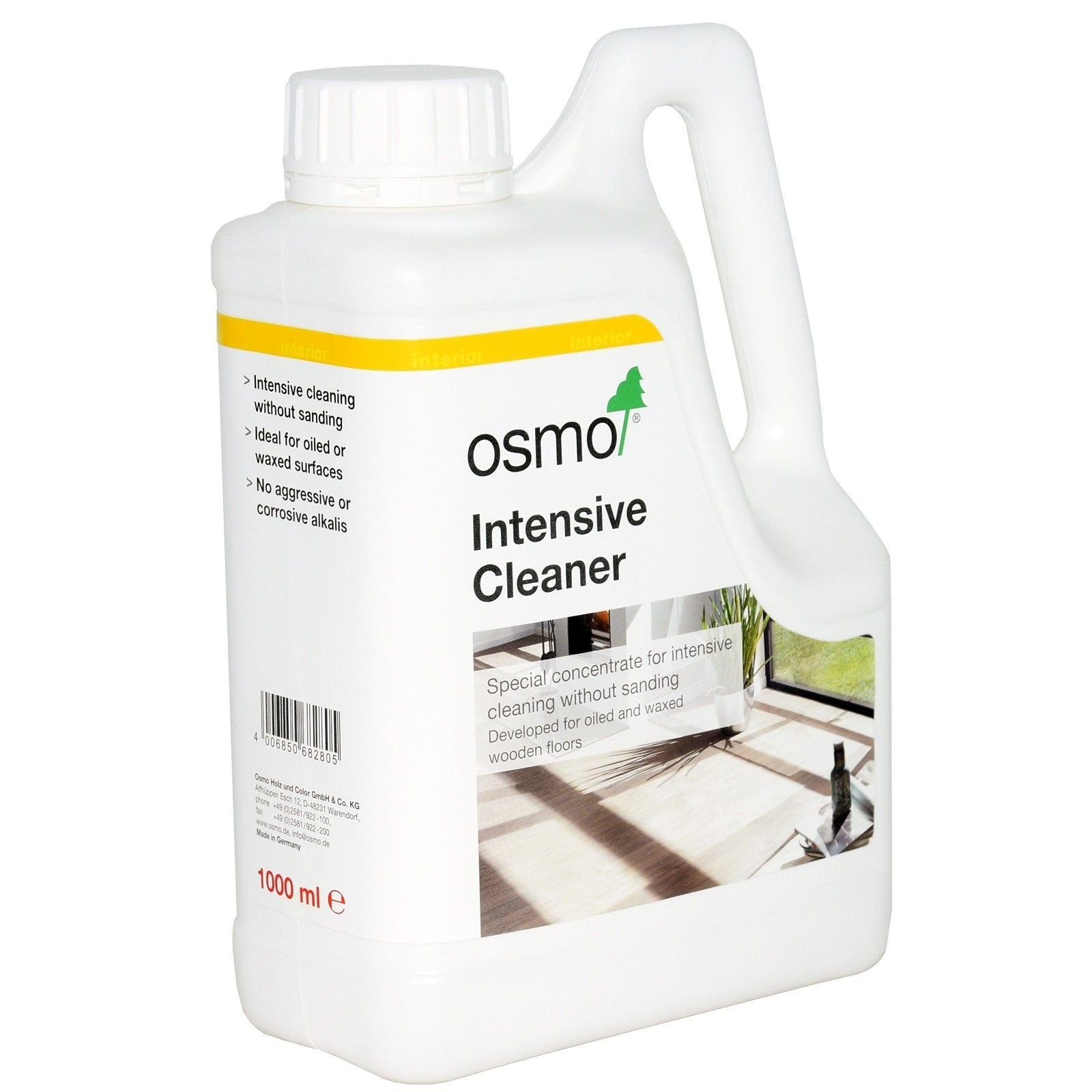
Weekly: Wash and Care in water. Dull traffic lanes: Liquid Wax Cleaner. Tired floor: Intensive Cleaner, then one coat of Maintenance Oil or the original Polyx-Oil. Scratches: Care & Repair Paste.
Our advice: never household soap or detergent on an oiled floor. It strips the wax and leaves it patchy, and it is the most common complaint we hear.
The outdoor wood oil for walked-on timber. The pigment is the UV protection, which is why a tinted oil outlasts a clear one. About 24 m² per litre per coat, two coats, dry in about 12 hours.
Our advice: new Balau, Garapa, Massaranduba and Iroko must weather 8 to 12 weeks before the first coat, or the oil sits on the timber's own oils and fails early.
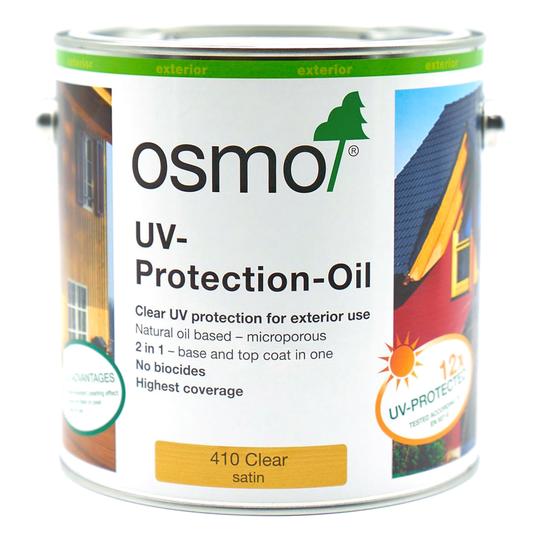
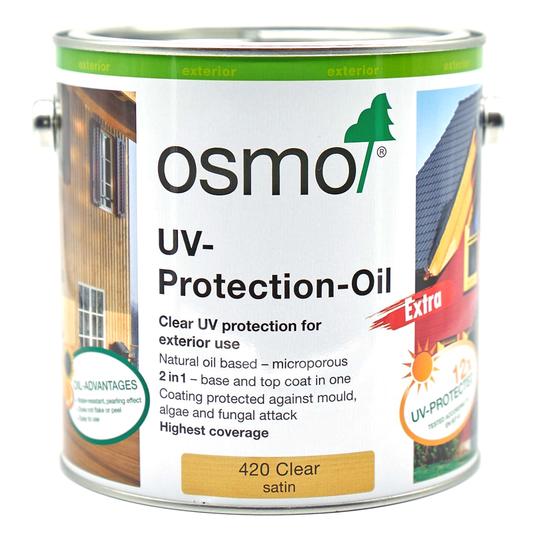
410 clear satin, no biocide · 420 EXTRA clear satin with film protection
For cladding, pergolas, gates, garden furniture and window frames: delays greying about twelve times. About 18 m² per litre per coat. Never on decking.
Our advice: 420 EXTRA for anything coastal, shaded or south-facing where algae and mould take hold; 410 for timber in full sun that dries fast.
Brush on, scrub, rinse, dry two to three days, then two thin coats of UV-Protection-Oil (tinted if you want it to last longer).
Our advice: once it is back to colour, one maintenance coat when the oil starts to wear (water no longer beads and the colour looks dry) keeps it there.
Clean each spring; re-oil when the oil is wearing and water no longer beads.
Our advice
Whatever the finder says, test the finish on an offcut before you open a 2.5 litre tin. Tints look different on Balau, oak, pine and Saligna, and Clear and Natural look different on the same board. That is why we sell Top-Oil, Decking Oil and Wash and Care in 5 ml sachets. If you are unsure, call 021 674 2119.
Interior
Interior wood finishes: floors, worktops, furniture and doors
Osmo marks interior tins in yellow. Three jobs, three products: Polyx-Oil for anything walked on, Top-Oil for anything you eat off, Wood Wax Finish and Oil Stain for colour and for timbers that will not take a normal oil.
Nine out of ten interior jobs are Polyx-Oil 3032 satin or 3062 matt, two thin coats. The mistakes we see are over-application (it stays tacky), sanding finer than P180 (the oil cannot get in) and household soap on the finished floor (it strips the wax). Get those three right and an Osmo floor is the easiest floor to own.
Exterior
Exterior wood oil: one rule decides the product
Osmo marks exterior tins in green, and the rule is simple. If water pools on it and people walk on it, it is horizontal and takes Decking Oil. If water runs off it, it is vertical and takes UV-Protection-Oil. The two are not interchangeable: UV-Protection-Oil wears through on a deck, and Decking Oil is not what cladding needs.
Vertical
Vertical: cladding, gates, pergolas, garden furniture, windows
UV-Protection-Oil 410 clear satin, no biocide: timber in full sun that dries fast.
UV-Protection-Oil 420 EXTRA with film protection against algae, mould and fungus: shaded, coastal, south-facing or damp.
Tints 424 to 432 for a natural colour that lasts longer, because the pigment is the UV protection.
Country Colour for solid, breathable colour. About 26 m² per litre.
About 18 m² per litre per coat · two coats new, one to maintain · dry in about 12 hours · delays greying roughly twelve times
An Osmo surface is maintained, never stripped: the right cleaner, one refresher coat when it looks tired, and the brush or roller that lays the oil down thin.
What our customers buy most, from our own sales over the last twelve months: Polyx-Oil Effect RAW, UV-Protection-Oil 420, Decking Oil 430 Anti-Slip, Polyx-Oil 3032 and 3062, Top-Oil and UV-Protection-Oil 410.
Osmo is a German manufacturer of natural hardwax oils, stains and waxes for timber. Power Tool Services is an Osmo stockist in Cape Town, holding the interior and exterior ranges at our Claremont shop with nationwide delivery across South Africa.
Osmo finishes are oil and wax based rather than film forming. They penetrate the timber, so they do not blister or peel, and a worn area can be cleaned and re-oiled in place instead of being sanded back. Use the finder and guide below to choose between Polyx-Oil, Top-Oil, Wood Wax Finish, Oil Stain, Decking Oil and UV-Protection-Oil, or call us on 021 674 2119.
Osmo is a German timber company that has worked with wood for over 140 years and has made its own oil and wax finishes since 1964. The oil penetrates the timber and the wax sits in the surface fibres, which is why an Osmo wood finish is water and dirt repellent yet still lets the wood breathe. Imported into South Africa by Osmo Africa in Cape Town; stocked and supported here at Power Tool Services.
Sunflower oil
Soya oil
Thistle oil
Linseed oil
Carnauba wax
Candelilla wax
Plant-based oils and hard waxes, refined in Osmo's own factory; no beeswax. Dry Polyx-Oil, Top-Oil and Wood Wax Finish meet the EN 71.3 toy-safety standard; Top-Oil and Chopping Board Oil are food safe to EN 1186.
South African timbers
Which Osmo for which timber
What we sell for the timbers that come across our counter in the Western Cape. Where Osmo has not published guidance for a species we say so: we recommend a sachet test on an offcut rather than guessing.
Timber
Where it is used
Osmo product and tint
What we tell customers
Balau
Decks, pool surrounds, screens, gates
Decks: Decking Oil 006 Bangkirai (darker) or 007 Teak (warmer), 430 Anti-Slip at the pool. Vertical: UV-Protection-Oil 410 / 420 EXTRA.
Dense and oily. New Balau must weather 8 to 12 weeks before the first coat. If it has greyed, Wood Reviver first.
Garapa
Decks, balconies, cladding
Decks: Decking Oil 013 Garapa. Cladding: UV-Protection-Oil, tinted for longer life.
The pale golden deck timber of the Western Cape. Weather 8 to 12 weeks; the 013 tint brings the colour back after weathering.
Massaranduba
Decks
Decking Oil 014 Massaranduba.
Red and very dense. Weather 8 to 12 weeks, thin coats, wipe off anything that sits on the surface.
Iroko
Gates, exterior joinery, decks, furniture
Decks: Decking Oil 011 Iroko. Gates and joinery: UV-Protection-Oil 410 / 420 EXTRA. Indoors: treat as an oily timber, Wood Wax Finish 1101 Clear Extra Thin.
Ingredient-rich: Osmo lists about 12 weeks of weathering outdoors. Test indoors on an offcut first.
Teak
Garden furniture, boats, decks, indoor furniture
Outdoors: UV-Protection-Oil 410 / 420 EXTRA after weathering; decks: Decking Oil 007 Teak. Indoors: Wood Wax Finish 1101 Clear Extra Thin.
Oily. Osmo lists about 12 weeks of weathering before an exterior oil. Oil Stain is not suitable on teak.
Kiaat
Furniture, doors, worktops
Wood Wax Finish 1101 Clear Extra Thin.
Oily tropical timber: the thin wax goes in where Polyx-Oil would sit on top. For a kiaat worktop, test Top-Oil with a sachet on an offcut first.
Saligna / Eucalyptus
Floors, furniture, decks
Ask us.
Osmo has not published guidance for Saligna. We have put Polyx-Oil on plenty of it, but tints read differently on every batch, so test on an offcut before committing to a tin.
Meranti
Windows, doors, frames
Ask us.
No published Osmo guidance for Meranti. Test the exterior oil on an offcut of the frame before you buy.
Pine (SA pine, pressure treated)
Floors, furniture, pergolas, decks
Floors and furniture: Polyx-Oil 3032 / 3062, or Effect RAW 3044 to keep whitewood pale. Outdoors: Decking Oil or UV-Protection-Oil after weathering.
Osmo lists about 12 weeks of weathering for pressure-impregnated pine. Soft and absorbent: it takes more oil than the coverage figure, so buy the next tin up.
Oak
Floors, tables, worktops, doors
Polyx-Oil 3032 / 3062; Effect RAW 3044 to stay pale; Oil Stain under Polyx-Oil for colour; Top-Oil on worktops.
The timber Osmo is built around. Clear and Natural Top-Oil look very different on oak, so test the sachets.
Ash
Floors, furniture
Polyx-Oil 3032 / 3062; Effect RAW 3044 keeps it pale.
Goes amber under a clear oil; most of our ash customers want RAW.
Our advice
Weathering is the step everyone wants to skip. Fresh hardwood is saturated with its own oils and closed on the surface; oil it now and the Osmo sits on top and wears off in months. Leave it 8 to 12 weeks, let it dull, then oil it and the colour comes back deeper than it went in.
From the counter
Common mistakes we see
Oiling a new hardwood deck the week it goes down
Balau, Garapa, Massaranduba and Iroko need 8 to 12 weeks of weather first. Oiled early, the finish sits on the surface and fails in a season.
UV-Protection-Oil on a deck
It is made for vertical timber and wears through under feet and standing water. Decks take Decking Oil; cladding takes UV-Protection-Oil.
Putting it on like paint
Osmo goes on thin and is wiped or brushed out. A thick coat stays tacky for days instead of curing. Coverage is about 24 m² a litre for a reason.
Sanding too fine
Stop at P120 on floors and P120 to P150 on furniture, never finer than P180. A burnished surface closes the pores and the oil cannot penetrate.
Household soap on an oiled floor
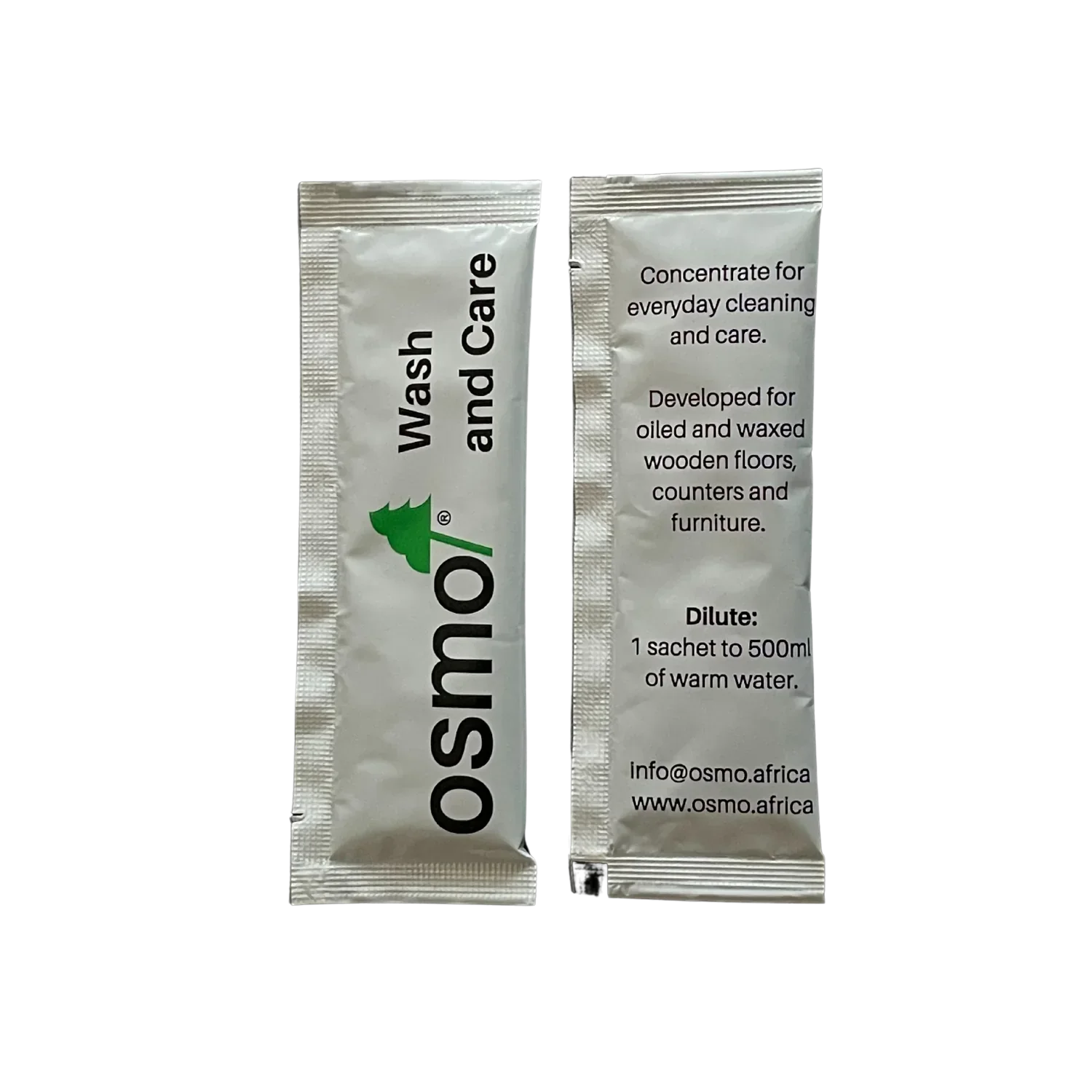
Detergents strip the wax and leave the floor patchy. Wash and Care 8016 in water is the only cleaner we recommend.
Pressure-washing a deck
It roughens the boards and drives water into the timber. Decking Cleaner, Wood Reviver and a stiff brush do the job without the damage.
Expecting a clear oil to stop greying
The pigment is the UV protection. Outdoors, tinted lasts longer than clear every time; opaque Country Colour lasts longest.
Not stirring the tin
Pigment and wax settle. Stir thoroughly before and during the job, never thin it, and do not shake it.
Oily rags in the bin
Rags and pads soaked in curing oil can self-ignite. Lay them flat outside to dry or seal them in a tin of water.
Skipping the test patch
Every tint looks different on every species. Try it on an offcut, or a 5 ml sachet on the underside, before the 2.5 litre tin is open.
Interior ranges in depth
Polyx-Oil, Top-Oil, Wood Wax Finish and Oil Stain
Polyx-Oil: the hardwax oil for wooden floors the range is built around
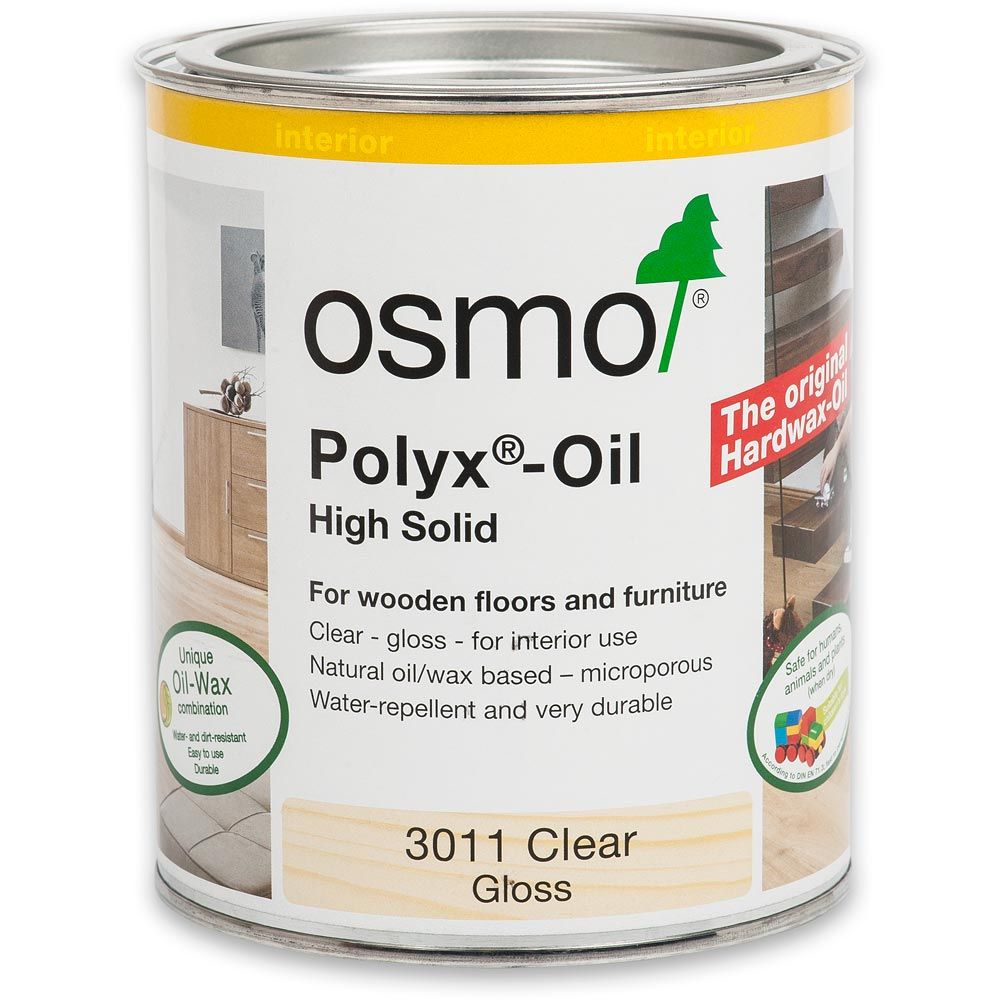
3011 Gloss
3032 Satin
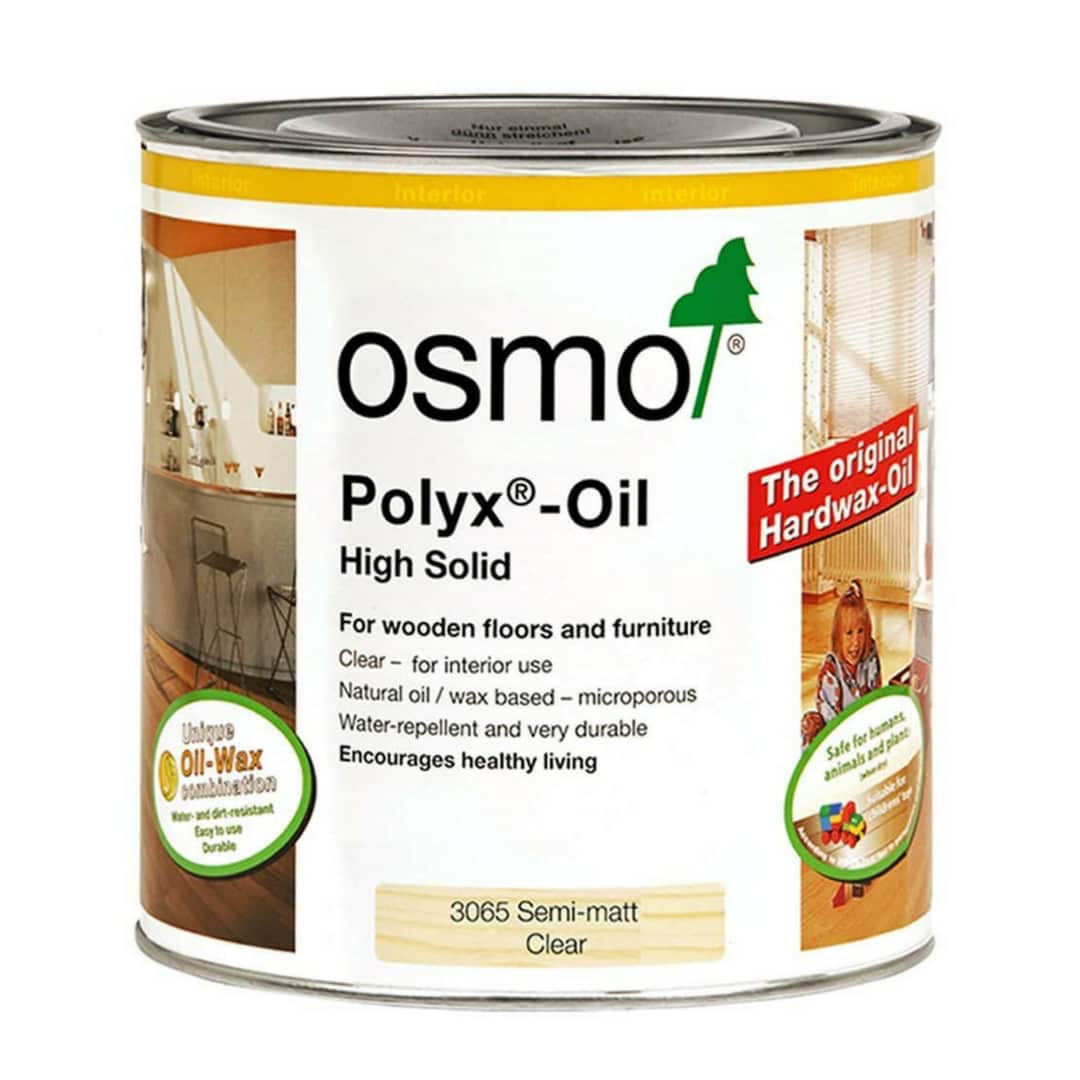
3065 Semi-Matt
3062 Matt
3044 Effect RAW
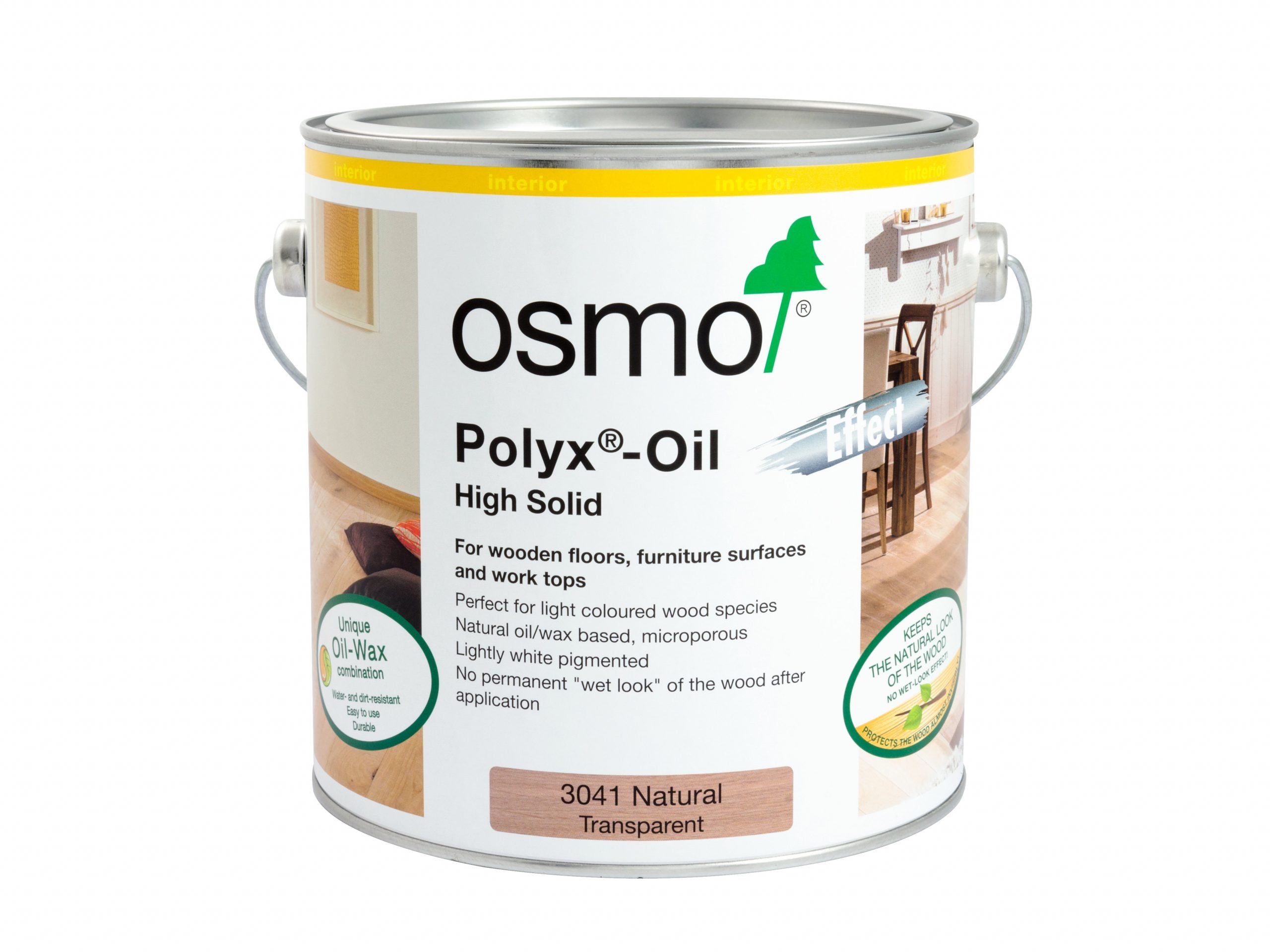
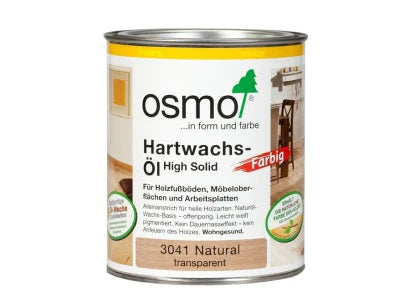
3041 Effect Natural
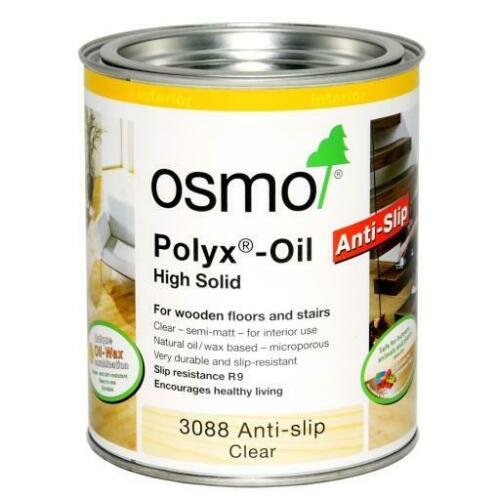
3088 Anti-Slip R9
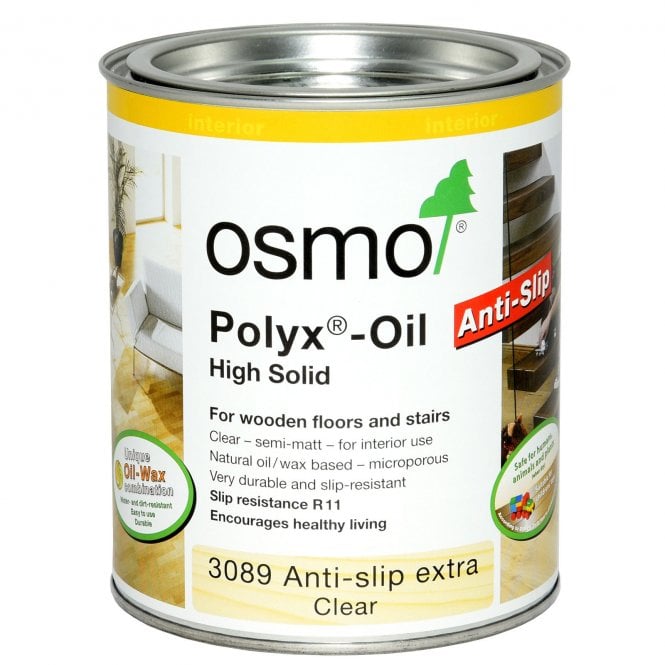
3089 Anti-Slip R11
Rapid 3232 / 3262 / 3240
Express + Hardener 6632
Tints 3040–3075
All of the Original Polyx-Oils protect the same way; the number is the sheen. One litre covers roughly 24 m² per coat, and a floor takes two thin coats about 8 to 10 hours apart at 23 °C. No sanding between coats, no primer, fully cured in 10 to 14 days.
Osmo 3032 satin is the everyday floor finish; Osmo 3062 matt gives the bare-timber look and hides wear best.
Osmo RAW (Effect RAW 3044) carries a trace of white pigment so pale timber stays pale instead of going amber. Our bestselling Osmo product.
Rapid is dry in 4 to 5 hours and Express (with Hardener 6632) in 1 to 3, for floors that must take both coats in a day.
Anti-Slip 3088 (R9) and 3089 (R11) for stairs, bathrooms and entrance halls.
Top-Oil, Door Oil and Chopping Board Oil: oil for furniture, worktops and doors
Top-Oil 3028 Clear Satin
3058 Clear Matt
3068 Natural
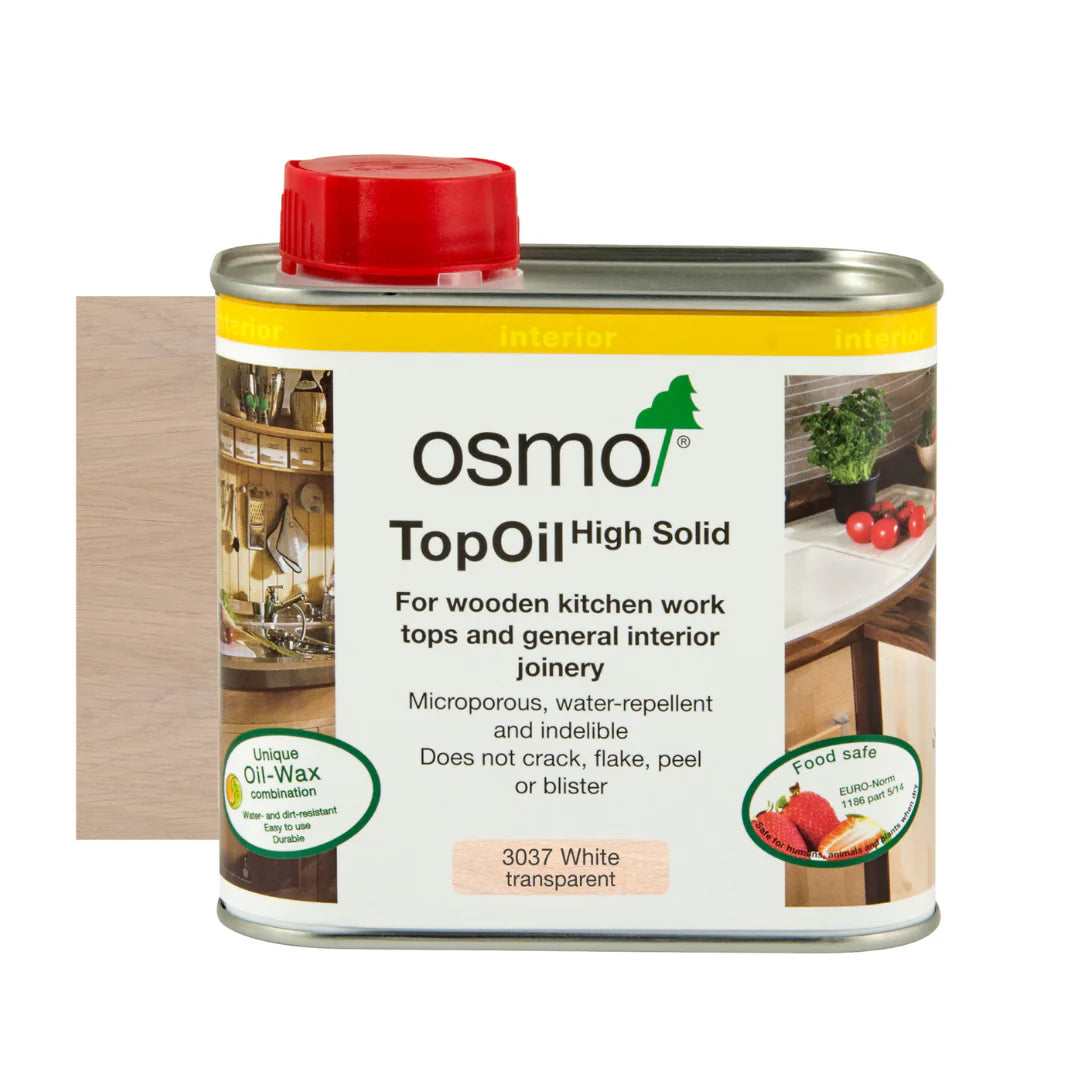
3037 White
3061 Acacia
3038 Terra
3039 Graphite
Door Oil 3060 / 3033
Chopping Board Oil
Top-Oil is a thinner hardwax oil for kitchen worktops, dining tables, shelves and any wood furniture you wipe down daily. Food safe once cured (EN 1186), toy safe (EN 71.3), and easy to spot-repair around a sink. Sold in 500 ml tins and 5 ml sachets so you can test Natural against Clear on an offcut first.
Door Oil is formulated for vertical surfaces, so it does not run on a door. Chopping Board Oil is for boards, bowls and utensils: wipe on, leave, wipe off, repeat when the board looks dry.
Wood Wax Finish and Oil Stain: wax for wood, and colour on interior timber
1101 Extra Thin
Wood Wax Finish Transparent
Intense Colours
Oil Stain 3501–3590 and tints
Hardener 6631
Wood Wax Finish 1101 Clear Extra Thin is for dense, oily or exotic timbers (teak, kiaat, wenge, rosewood) that will not take a normal hardwax oil, and doubles as the thinner for the range. Transparent and Intense Colours give colour and protection in one, from a translucent wash to solid white or black, toy safe for children's furniture.
Oil Stain is a thin colour coat sealed with clear Polyx-Oil, which is how a coloured oak floor still wears like a clear one. Not for oily tropical timbers. We hold the full tint card: Natural 3519, White 3501, Graphite 3514, Havanna 3541, Cognac 3543, Tobacco 3564, Black 3590 and the rest.
Decking Oil and UV-Protection-Oil: outdoor wood oil for South African sun
Decking Oil 007 Teak
006 Bangkirai
013 Garapa
014 Massaranduba
011 Iroko
009 Larch
019 Grey
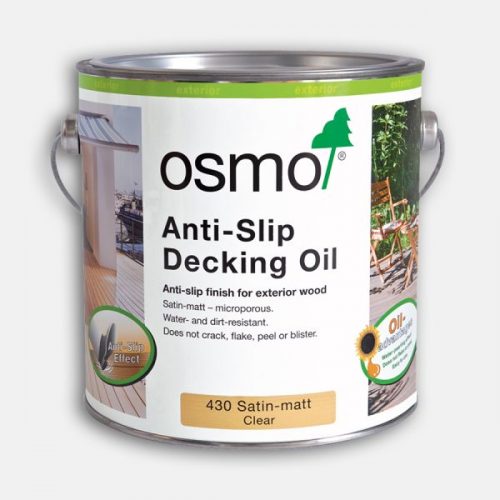
430 Anti-Slip
UV-Protection-Oil 410
420 EXTRA
UV tints 424–432
Country Colour
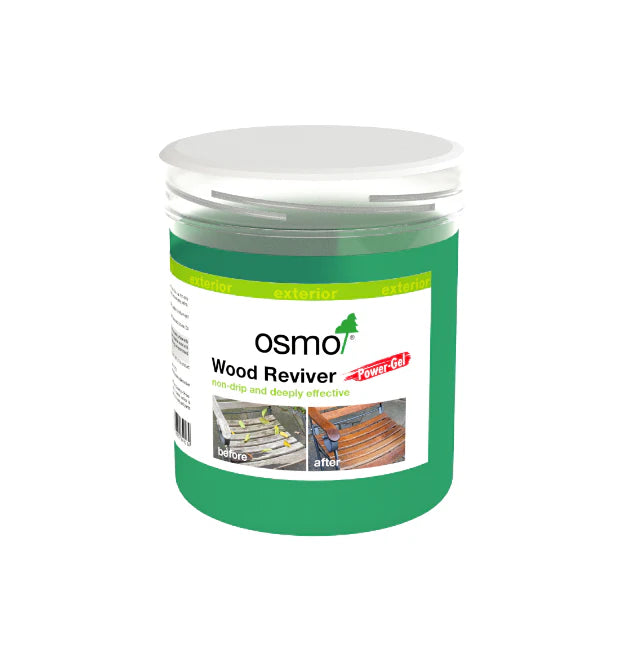
Wood Reviver 6609
Decking Oil is a tinted penetrating oil for horizontal, walked-on timber. The tint is matched to the species so the deck keeps its colour; it is the pigment that gives the UV protection, which is why a clear oil outdoors never lasts as long as a tinted one. 430 Anti-Slip adds grip for pool surrounds, steps and jetties.
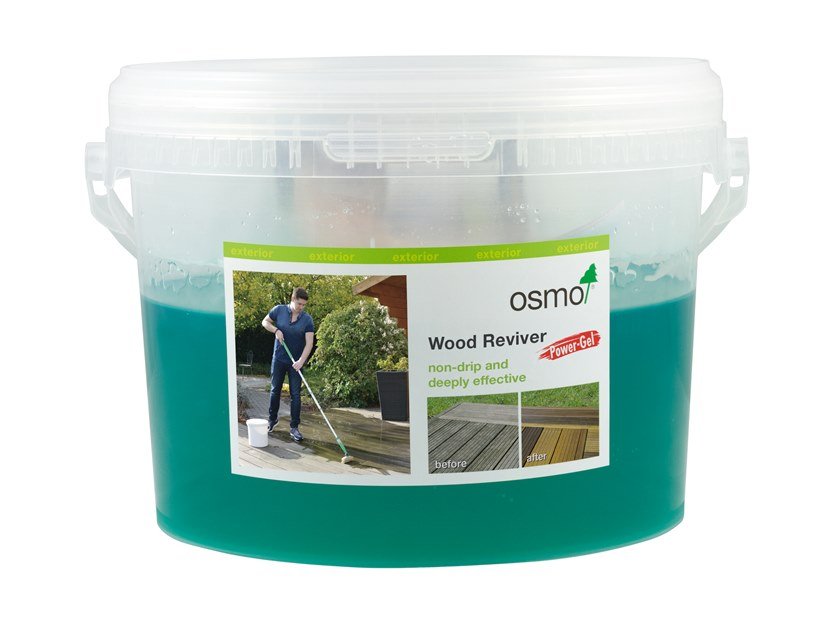
UV-Protection-Oil is the clear or lightly tinted finish for vertical exterior timber: cladding, pergolas, gates, garden furniture and window frames. 410 has no biocide, for sunny, fast-drying positions; 420 EXTRA adds film protection against algae, mould and fungus for shaded, coastal or damp elevations. Country Colour is the opaque option. Grey timber gets Wood Reviver Power-Gel 6609 first.
Yes: active against algae, mould and fungal growth on the surface
Best position
Full sun, well ventilated, dries quickly after rain
Shade, south-facing, coastal, under trees, anywhere that stays damp
Typical jobs
Garden furniture, pergola beams in sun, window frames, planter boxes
Cladding, gates, fences, pergolas near pools, timber near the sea
UV protection
Identical: the same UV filters, delaying greying roughly twelve times longer than untreated timber. Tints 424 to 432 add pigment for longer life.
Coverage and coats
About 18 m² per litre per coat; two coats new, one coat to maintain; dry in about 12 hours. Vertical surfaces only.
Inspiration
Osmo wood finishes in real rooms
The same three decisions every time: which range for the surface, which sheen, and whether the timber should stay pale, warm up or take a colour.
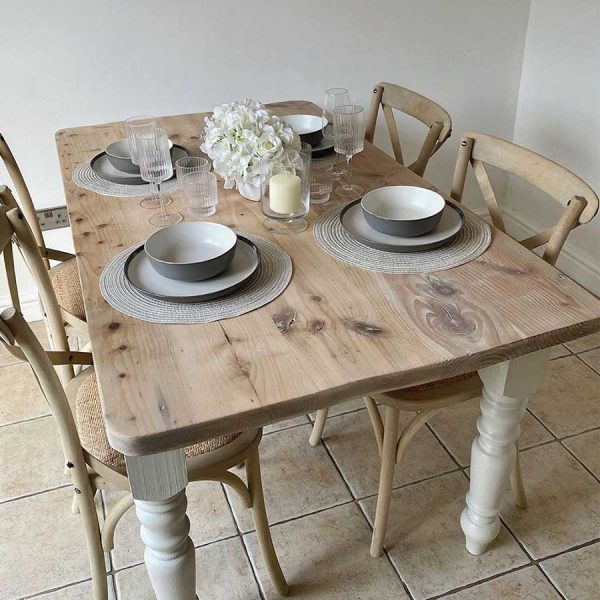
Dining table: Polyx-Oil Effect RAW 3044Pale timber kept pale. Hard-wearing, wipeable, repairable at the table edge where chairs knock.
Living room floor: Polyx-Oil Tint 3040 WhiteOne coat of white tint for a Scandi wash, sealed with clear Polyx-Oil 3062 matt.
Floor: Oil Stain 3514 Graphite + Polyx-OilColour from the stain, wear from the clear top coat. Not for oily tropical timbers.
Application
How to apply Osmo wood oil
Osmo goes on thin. Sand floors to P120 and furniture to P120 to P150 (never finer than P180), remove the dust, stir the tin without thinning, and work along the grain in a well ventilated room. Two thin coats; no sanding between them.
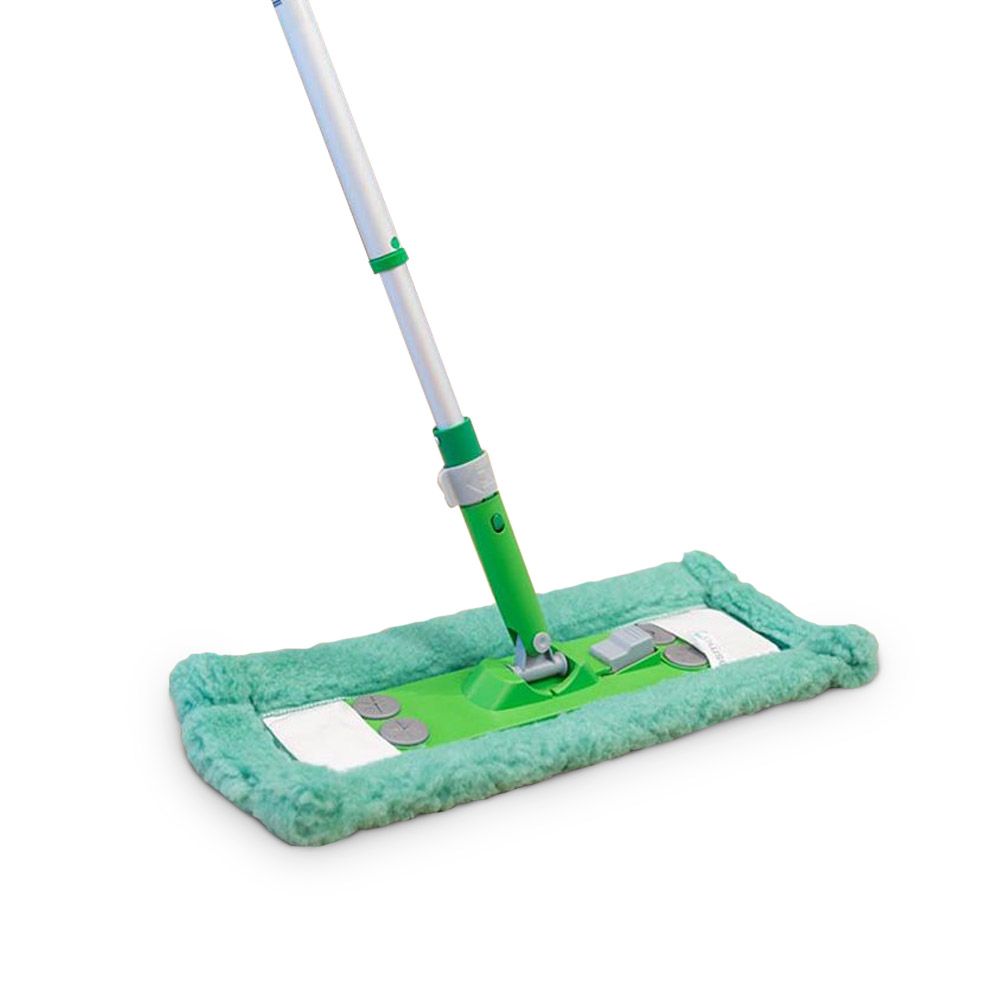
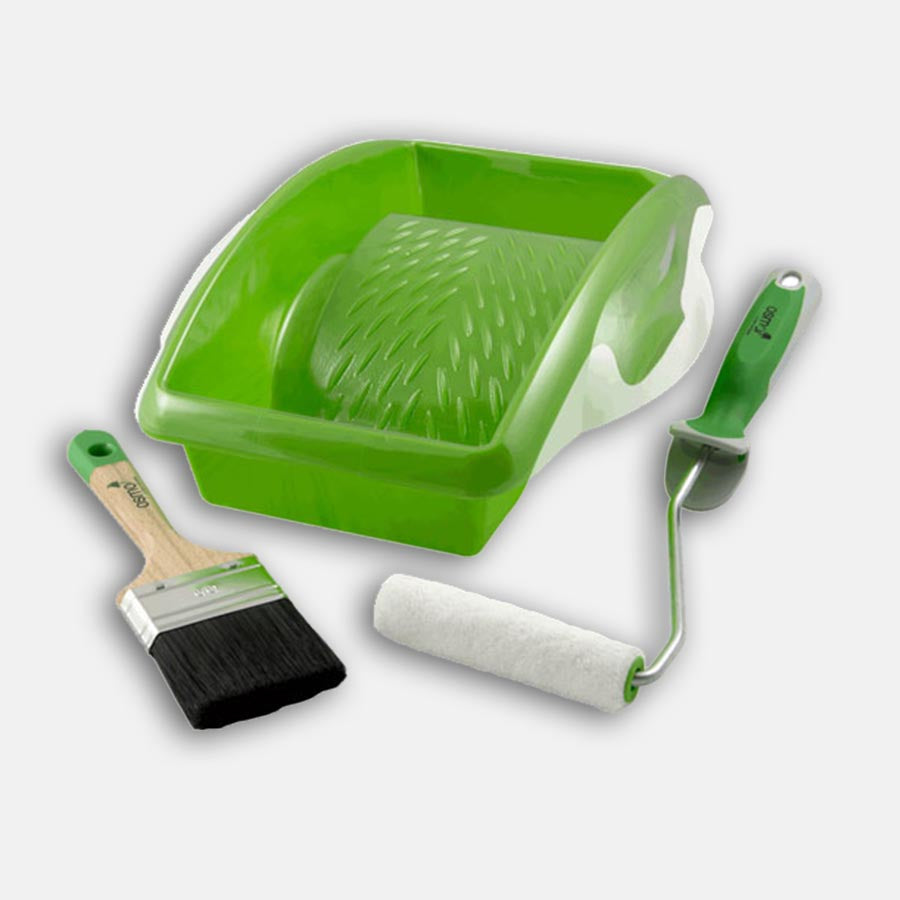
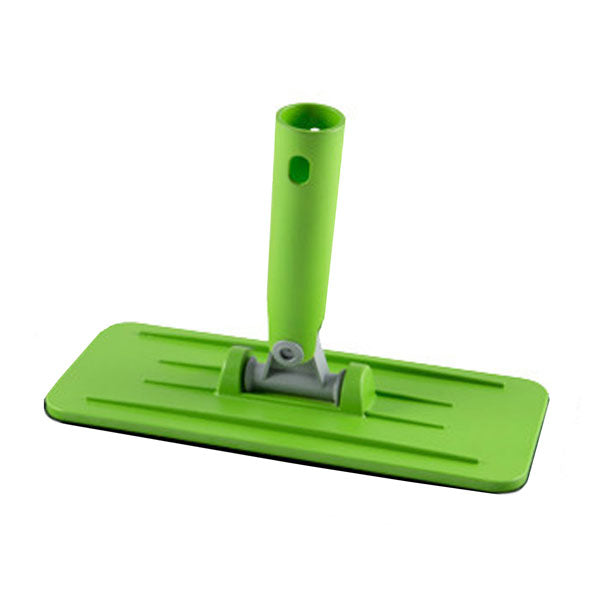
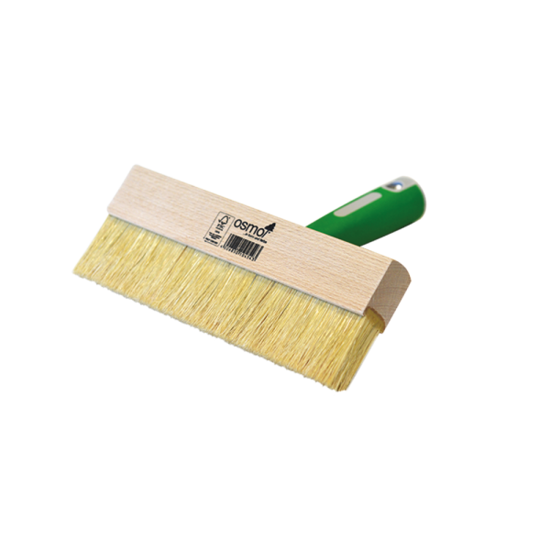
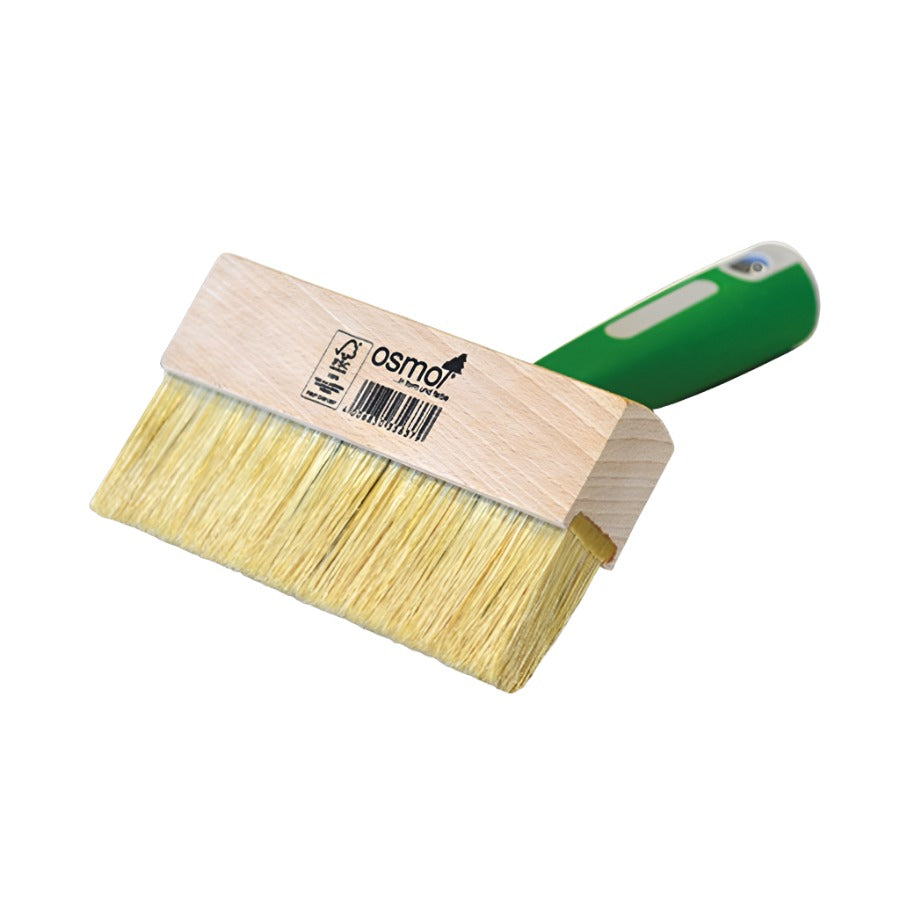
Floors: Osmo Floor Brush
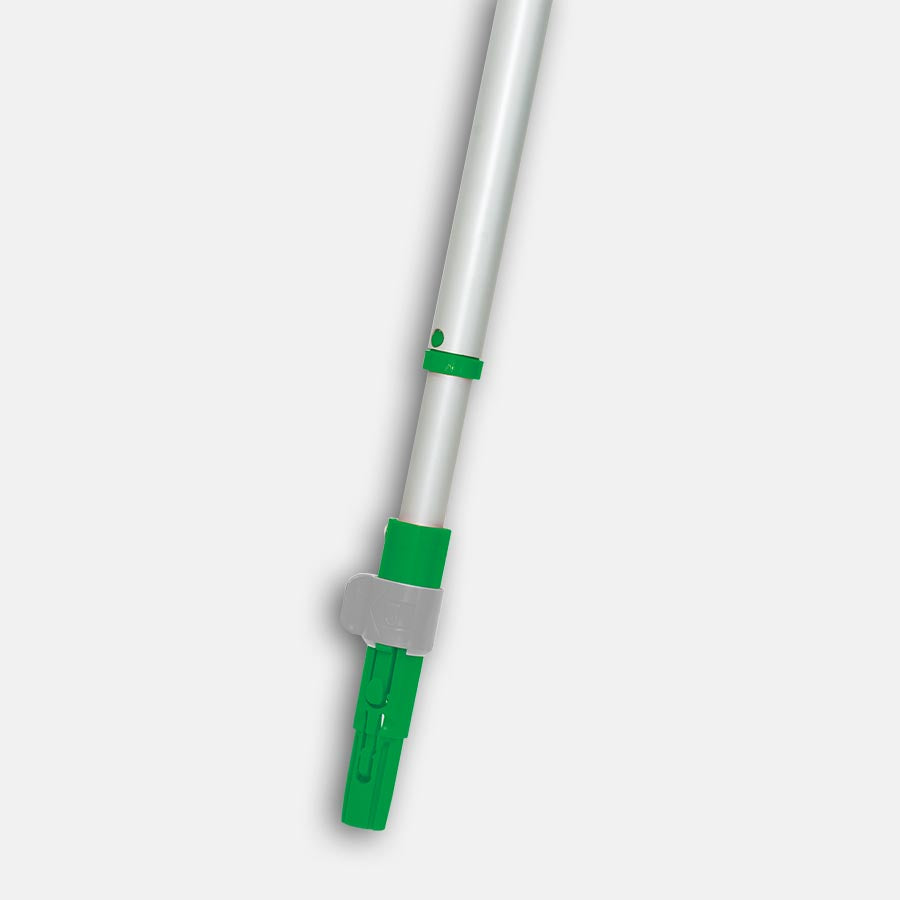
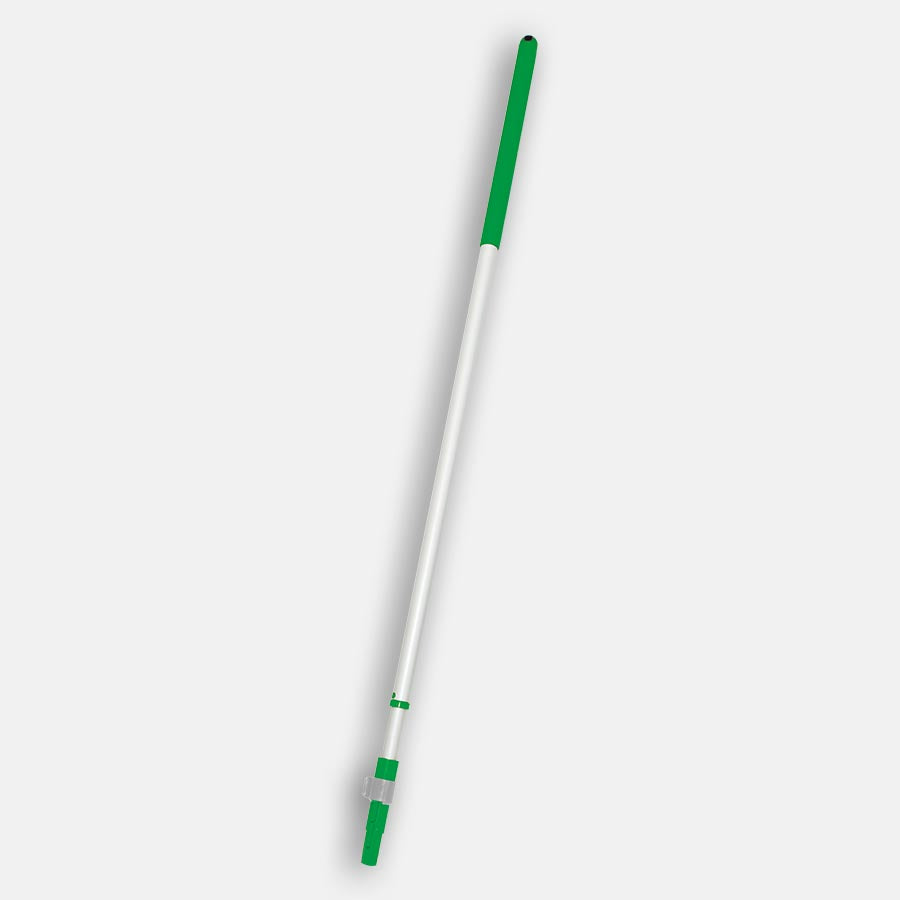
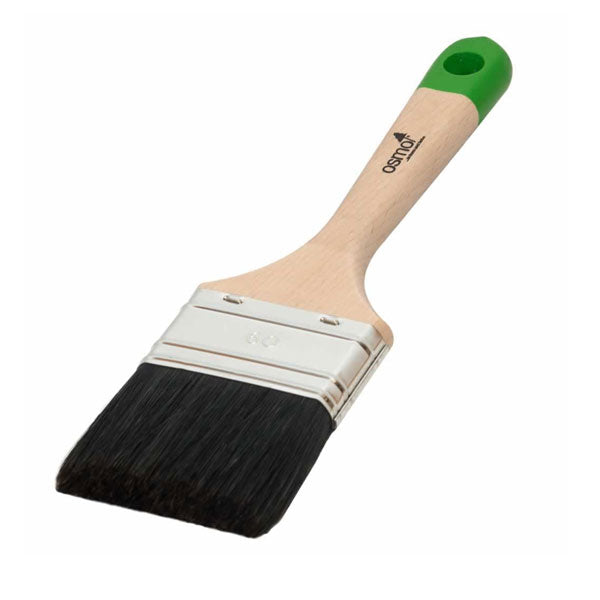
Natural bristle brush on the telescopic handle. Spread a thin coat along the grain, keep a wet edge, and do not go back over areas that have started to set. Second coat after 8 to 10 hours.
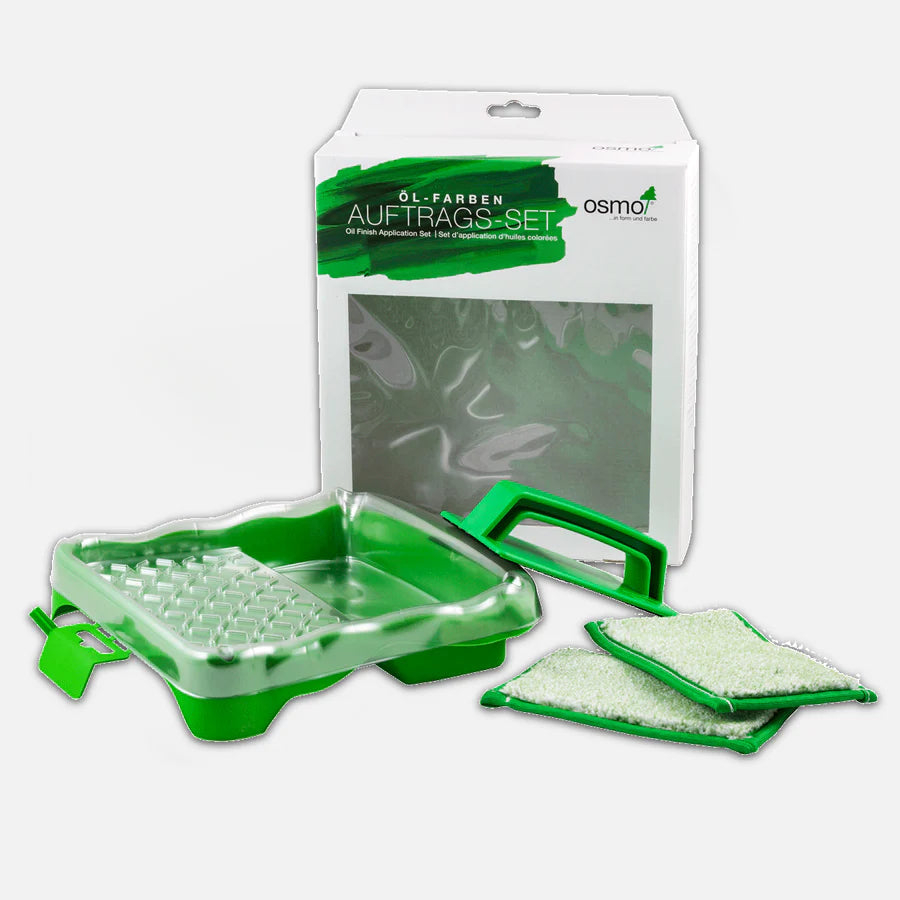
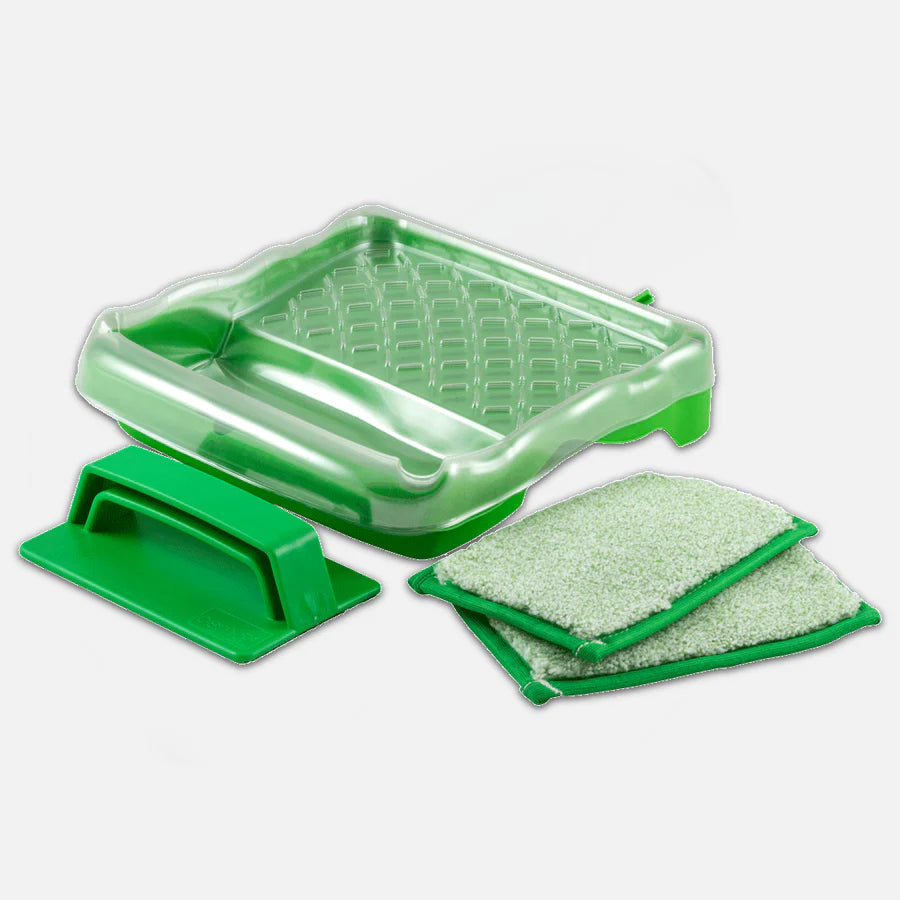
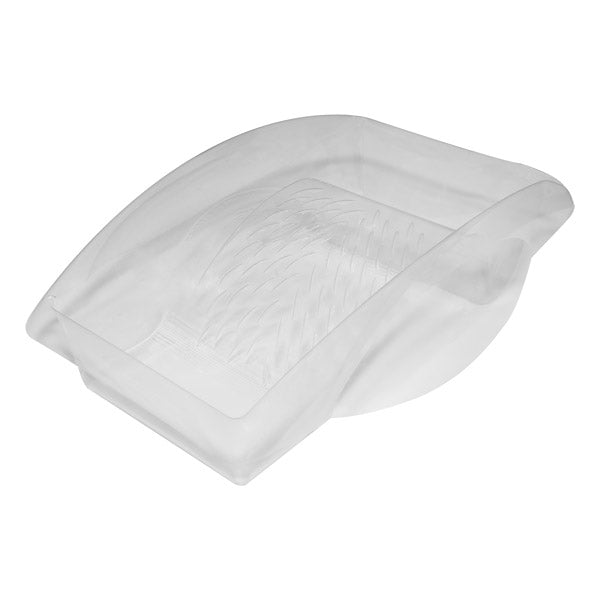
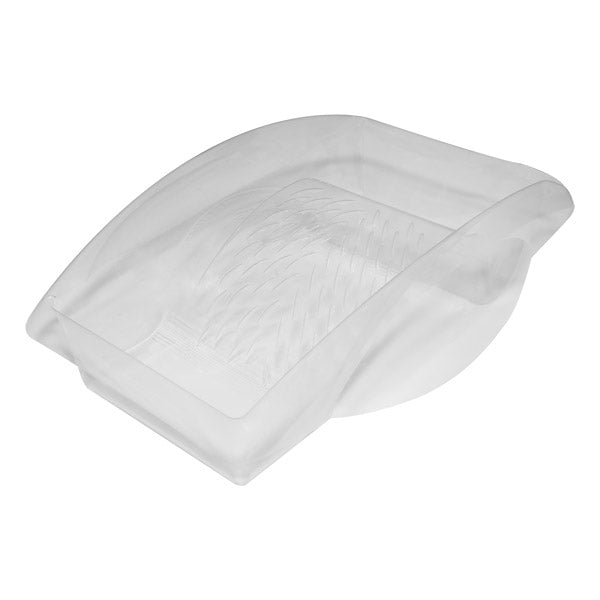
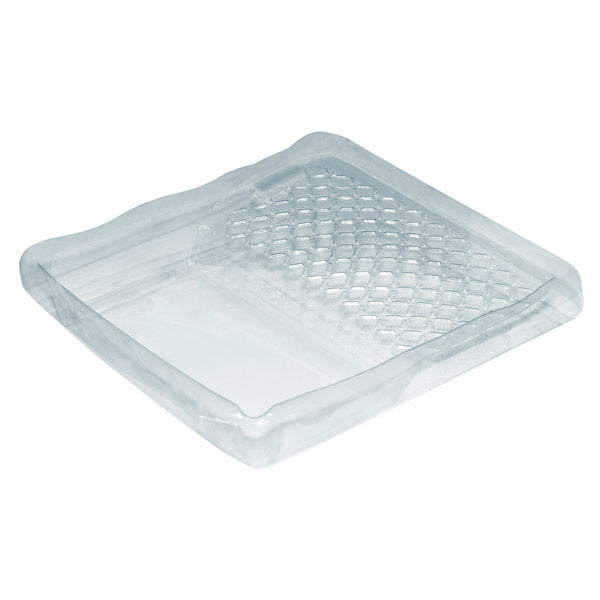
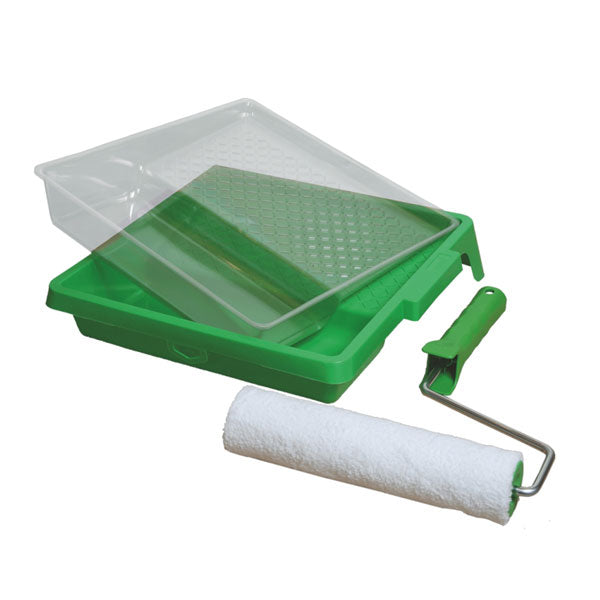
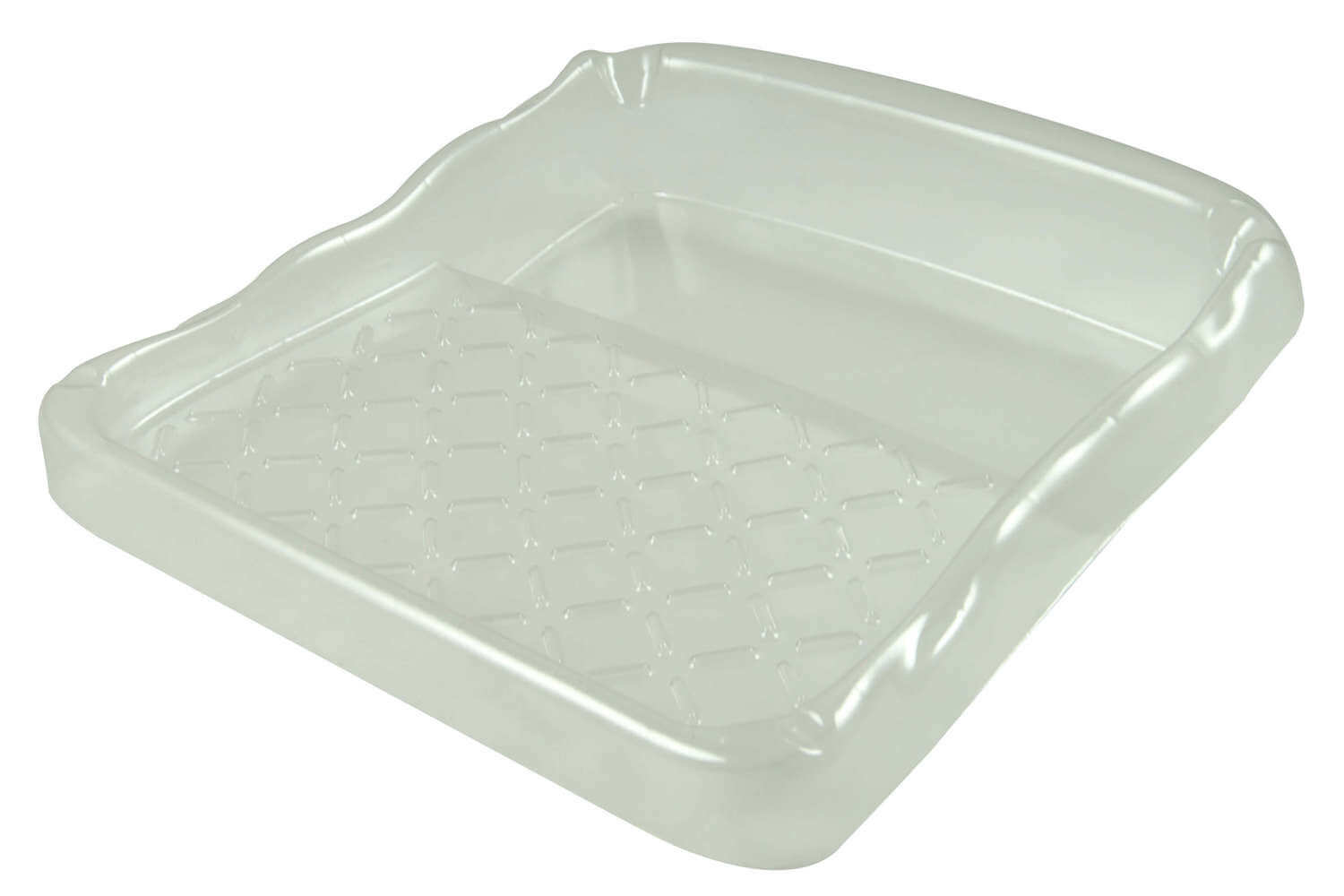
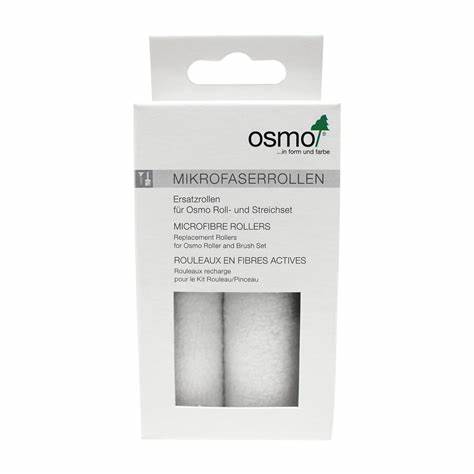
The microfibre roller lays down the thinnest, most even film and is the fastest way to do a big floor. Use the tray inserts so the tray stays clean between coats.
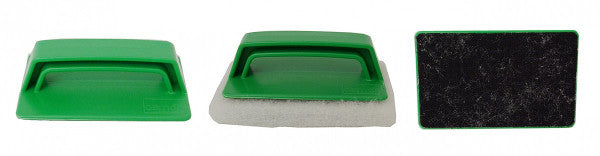
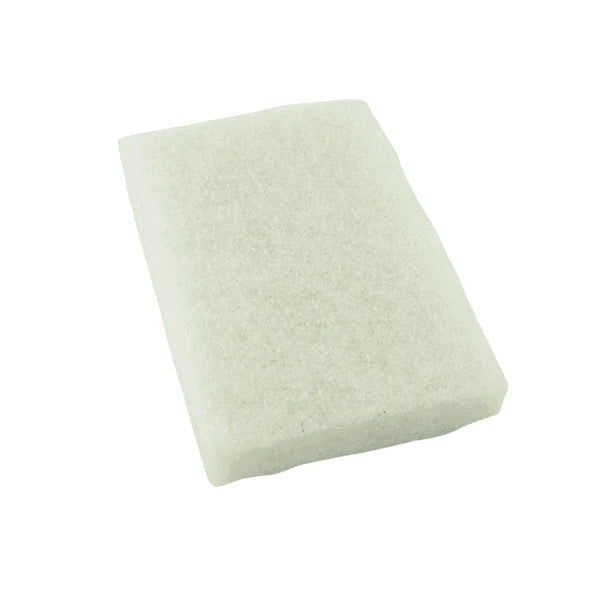
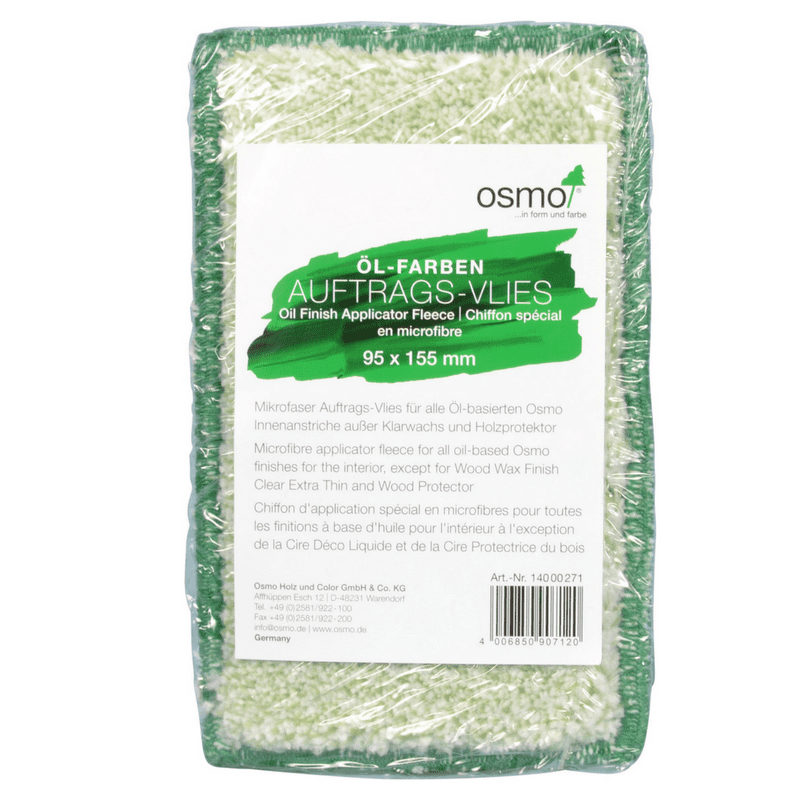
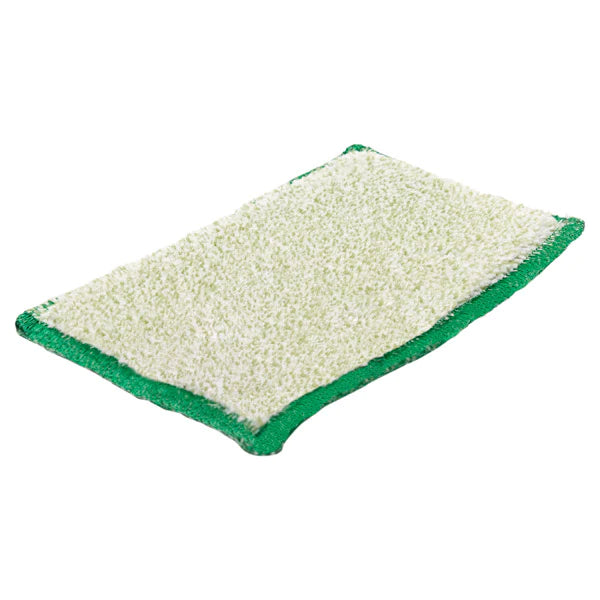
Wipe a thin coat on with the applicator fleece, then wipe off along the grain so nothing pools. By cloth you can build three or four very thin coats on a hard-use worktop.
Weathered, clean timber only. Work board by board along the grain with the 150 mm decking brush, thin and even, and wipe pooling off the end grain. Two coats about 12 hours apart.
Oily rags can self-ignite. Cloths, pads and fleeces soaked in oil heat up as the oil cures. Lay them flat outside to dry completely, or seal them in a tin of water, before you throw them away. Never leave them scrunched up in a bin.
Calculator
How much Osmo oil do I need?
Coverage figures are Osmo's for smooth, planed timber. Rough-sawn, end grain and very absorbent softwoods take noticeably more. Buy the next tin size up and keep the remainder for maintenance coats.
Watch
See Osmo applied
Maintenance
Caring for oiled wood floors, furniture and decks
When a floor or deck starts to look tired you clean it and put one thin coat back on, without sanding. That is the whole point of the system.
74 Osmo lines held in stock at 221 Imam Haron Road, Claremont, Cape Town, including the 2.5 litre tins and the full Oil Stain and Decking Oil tint cards. Collect today or we courier nationwide; delivery is free over R2000.
Sachets, so you can test first
Tints look different on Balau, oak, pine and Saligna. We stock Top-Oil, Decking Oil and Wash and Care in 5 ml sachets so you can test on an offcut at home before you commit to a tin.
Advice from people who use it
We sell the sanders that prepare the timber as well as the finish, so we can tell you what grit to stop at, which applicator to use, and whether your job wants 410 or 420. Call 021 674 2119.
Also looking at a one-coat system? We stock Rubio Monocoat alongside Osmo and are happy to compare the two for your job.
FAQ
Osmo wood finish questions
Interior
What is the difference between Osmo Polyx-Oil and a varnish or sealer?
A varnish forms a film on top of the wood. It looks good until it is scratched or the sun gets to it, then it cracks, peels and has to be sanded back. Polyx-Oil penetrates the timber and hardens inside the surface fibres, so there is no film to peel. Worn areas are cleaned and re-oiled in place, and the finish is microporous so the wood can still breathe.
Which Osmo Polyx-Oil sheen should I choose for a wooden floor?
Satin 3032 is the most popular floor finish: enough sheen to look finished without showing every footprint. Matt 3062 is the choice for a modern, bare-timber look and hides wear best. Gloss 3011 is rarely used on floors. If the timber is pale and you want it to stay pale, use Effect RAW 3044 instead of a clear oil, which would warm the colour.
What is the best oil for wood furniture and tables?
For a dining table, desk or shelving in daily use, Polyx-Oil 3032 satin or 3062 matt, two thin coats by cloth or fleece. For a worktop or any surface that meets food, Top-Oil. For dense or oily timbers such as teak, kiaat and wenge, Wood Wax Finish 1101 Extra Thin, the thin wax for wood that will not take a normal oil. All three are wiped on thin and wiped off, and all three are repaired by re-oiling the worn patch rather than stripping the piece.
Is Osmo safe for kitchen worktops, chopping boards and children's furniture?
Yes once cured. Top-Oil and Chopping Board Oil are tested safe for food contact to EN 1186, and dry Polyx-Oil, Top-Oil and Wood Wax Finish meet the EN 71.3 toy-safety standard. Allow the full 10 to 14 day cure before putting food directly on the surface.
Exterior
Which Osmo decking oil should I use on a Balau or Garapa deck in South Africa?
Osmo Decking Oil in the tint that matches the species: Bangkirai 006 or Teak 007 on Balau, Garapa 013 on Garapa, Massaranduba 014 on Massaranduba, Iroko 011 on Iroko. A new hardwood deck must weather for 8 to 12 weeks before its first coat, otherwise the oil sits on top of the natural oils in the timber. If the deck is already grey, treat it with Wood Reviver Power-Gel first, rinse, and let it dry for two to three days. For pool surrounds and steps use 430 Anti-Slip. Two coats on a new deck, then one thin coat whenever the oil is wearing and water no longer beads.
What is the difference between UV-Protection-Oil 410 and 420?
Both contain the same UV filters and look the same. 420 EXTRA adds a biocide film protection against algae, mould and fungus, so it is the one for shaded, coastal or damp positions and for cladding that stays wet after rain. 410 has no biocide and suits timber in full sun that dries quickly, or anywhere you would rather avoid biocides. Neither is for decking: horizontal timber takes Decking Oil.
What is the best outdoor wood oil for garden furniture, a pergola or a gate?
UV-Protection-Oil: 410 in full sun, 420 EXTRA where it is shaded, coastal or damp. Choose a tint (424 to 432) rather than clear if you want the colour to last, because the pigment is what blocks the UV. Oily timbers such as teak and Iroko should weather about 12 weeks first. Two thin coats, about 18 m² per litre per coat, then one refresher coat when the oil wears: Osmo gives two to three years in high exposure, three to four moderate, four to five low.
How do I bring grey, weathered wood back before oiling it?
Wet the timber, brush on Osmo Wood Reviver Power-Gel 6609 along the grain (about 10 m² per litre), scrub, leave it to work, then rinse well. Let the wood dry for two to three days before applying Decking Oil or UV-Protection-Oil. It is a wood reviver, not a stripper: it lifts the grey, oxidised surface and brings the colour back without pressure-washing, which roughens the timber and drives water into it.
Application
How many coats of Osmo do I need and how long does it take to dry?
Two thin coats on new or sanded timber, one coat when maintaining. Polyx-Oil and Top-Oil are dry enough for the next coat after 8 to 10 hours at 23 °C, Decking Oil and UV-Protection-Oil after about 12. Allow a day before light use and 10 to 14 days before the surface is fully hardened and water resistant. Rapid dries in 4 to 5 hours and Express in 1 to 3. If a coat stays sticky it was put on too thick, or the room is cold, humid or unventilated.
How much does a litre of Osmo cover?
Roughly 24 m² per litre per coat for Polyx-Oil, Top-Oil and Decking Oil on smooth timber, about 18 m² for UV-Protection-Oil and 26 m² for Country Colour, which is about double a conventional finish because it goes on so thin. Rough-sawn timber and end grain absorb more. Use the calculator above to size the tin.
Do I sand between coats of Osmo, and what grit should I stop at?
No sanding between coats. Sand the bare timber to P120 for floors or P120 to P150 for furniture, remove the dust, apply the first thin coat, let it dry, and apply the second straight on top. Never sand finer than P180 or the oil cannot penetrate. If the first coat has raised the grain on a very soft timber you can lightly de-nib with a P320 pad, but it is not part of the normal process.
Can I put Osmo over an existing finish or a previously oiled floor?
Over a previously Osmo-oiled floor, yes: clean it with Intensive Cleaner and apply one maintenance coat. Over another brand of oil, usually yes after a thorough clean, but test a patch. Over varnish, lacquer, polyurethane or paint, no: the oil cannot penetrate a film, so the old finish has to be sanded back to bare timber first.
Care
How do I clean and maintain an Osmo oiled floor?
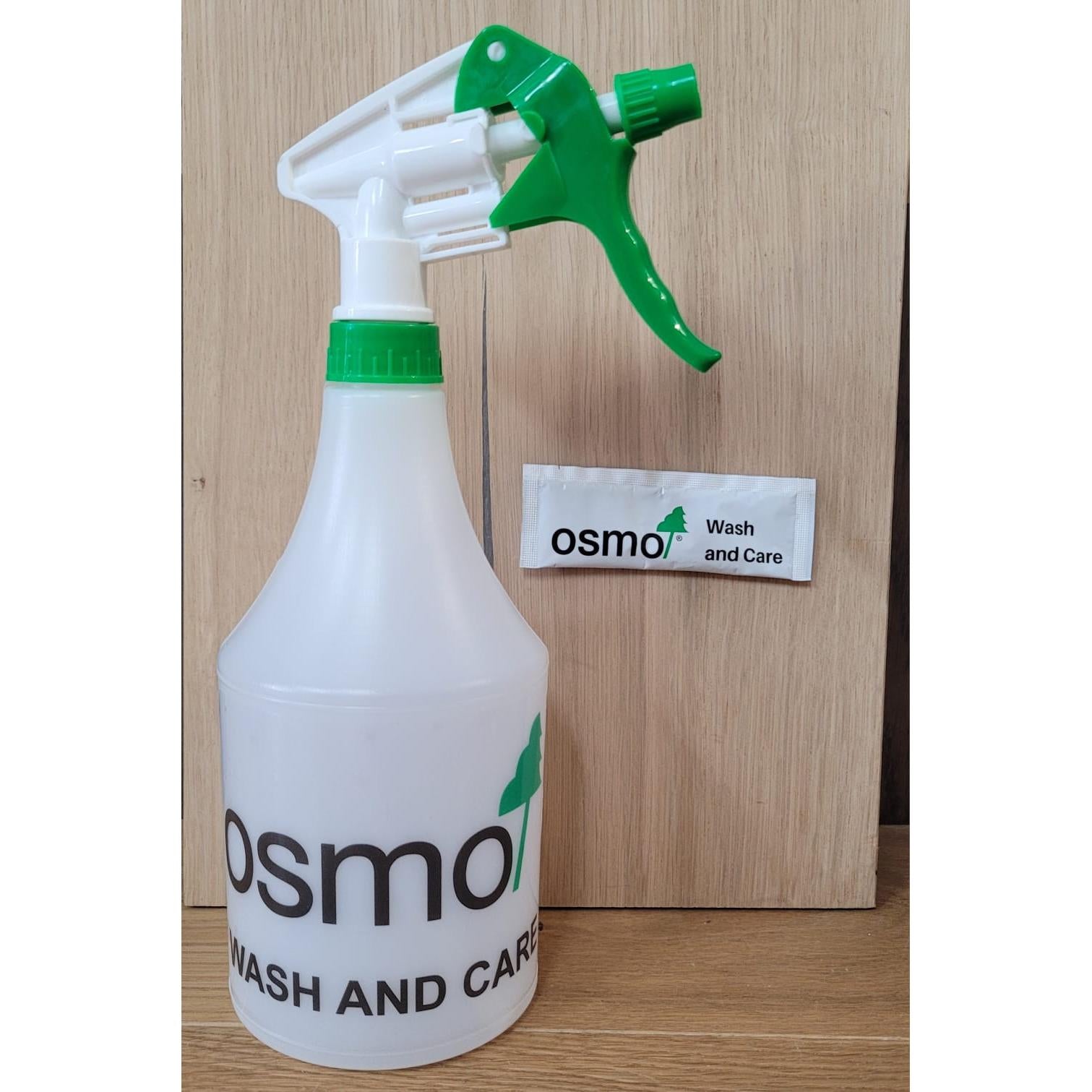
Vacuum or dust mop, then wash with Osmo Wash and Care 8016 diluted in water, with a damp mop rather than a wet one. Do not use household detergents or soap-based floor cleaners; they strip the wax and leave the floor patchy, which is the most common Osmo complaint we hear. Every few months use Liquid Wax Cleaner in traffic lanes, and put on a maintenance coat of oil every one to three years.
How often does an oiled deck need re-oiling?
When the oil is wearing: water no longer beads and the colour looks dry. Osmo does not fix a deck interval because exposure varies so much; for UV-Protection-Oil on vertical timber it publishes two to three years in high exposure, three to four in moderate and four to five in low. A deck in full Cape sun sits at the short end of that. Clean it with Decking Cleaner 8025, let it dry, and put on one thin coat of the same Decking Oil; there is no sanding and no stripping. If it has gone grey because it was left too long, Wood Reviver Power-Gel first. Never pressure-wash it.
Buying
Where can I buy Osmo oil in Cape Town, and do you deliver to Johannesburg, Durban and the rest of South Africa?
Power Tool Services stocks the full Osmo range at 221 Imam Haron Road, Claremont, Cape Town, a short drive from Osmo Africa, the importer in Ottery. Order online and we courier anywhere in South Africa, including Johannesburg, Pretoria, Durban, Gqeberha and the Garden Route; delivery is free on orders over R2000. Oil-based finishes ship by road freight, not air.
Which tin size should I buy?
Work out the litres with the calculator above, then buy the next size up and keep the remainder for the maintenance coat: a 125 ml or 375 ml tin for a table or a door, 750 ml for a small room or a worktop and its offcuts, 2.5 litres for a floor or a deck. Decking Oil and Oil Stain come in a full range of tints, and Top-Oil, Decking Oil and Wash and Care in 5 ml sachets for testing.
Osmo or Rubio Monocoat?
Both are penetrating oil finishes we stock and recommend. Rubio Monocoat Oil Plus 2C is a single-coat system with a very wide colour range, popular on furniture and on floors where speed matters. Osmo is a two-coat hardwax oil with more sheen options, a dedicated anti-slip floor finish, and a bigger exterior range. Bring the job to us and we will tell you which suits it.
Reviews from our customers
Ready to experience our excellent service? Get in touch!



 Vertical
 006 BangkiraiBalau, darker
 007 TeakBalau, warmer
 013 GarapaGarapa, golden
 014 MassarandubaRed hardwoods